A personal locator beacon (PLB) is a compact emergency transmitter that sends a satellite distress signal with your GPS coordinates to search and rescue authorities. That’s what the definition says. But do you really need it?
For my first few years of diving, I figured the boat would always be there when I surfaced. Then one afternoon off Caño Island, I watched a current carry two experienced divers nearly a kilometer from the pickup point in under ten minutes. We found them. It took forty minutes of searching, two radio calls, and one very nervous captain.
That was me. I was the nervous captain. After eight years of running dive operations at Costa Rica Divers and teaching hundreds of students in open Pacific waters, I’ve learned that the ocean doesn’t care how confident you are. Having a way to say “I’m right here” when things go sideways is not paranoia. It’s basic planning.
In this guide, I’ll walk you through the three types of rescue devices available to divers, explain exactly how each one works, compare the top models side by side, and help you figure out which one (if any) makes sense for your type of diving. No sales pitch. Just the honest breakdown I wish someone had given me before that afternoon off Caño.
What Is a Personal Locator Beacon and Why Should Divers Care?
A personal locator beacon is a small electronic device that transmits an emergency distress signal when you activate it. The signal goes up to satellites, which relay your position to a Rescue Coordination Center. From there, search and rescue teams are dispatched to your GPS coordinates. The whole system is called COSPAS-SARSAT, and it’s operated by an international network of governments. No subscription fees. No monthly charges. You press the button, satellites hear you, and rescue comes.
For divers, the concept is simple but the context is specific. You can’t activate a PLB underwater because the signal won’t reach satellites through water. You carry the device in a waterproof canister clipped to your BCD, surface, pull it out, extend the antenna, and press the button. It’s a surface rescue tool that you happen to transport on a dive.
It’s a matter of your safety
Now here’s the part that makes this personal for me. When a diver goes missing from one of our boats, the search pattern is brutal. You’re scanning open ocean, fighting current, trying to spot a tiny head bobbing between swells. A diver with a surface marker buoy is easier to find. A diver with a whistle or mirror, better still. But a diver whose GPS coordinates are pinging on every AIS-equipped vessel within 34 miles? That diver gets found fast. That’s the difference a rescue device makes, and it’s a difference I’ve seen play out in real conditions.
A PLB doesn’t prevent emergencies. It dramatically shortens the gap between “missing” and “found.” For open-water diving, that gap is everything.
PLB vs AIS vs Satellite Messenger: What’s the Difference?
This is where most articles get confusing, so let me clear it up for you right now. There are three fundamentally different types of rescue devices marketed to divers. They use different technology, reach different people, and work in different situations. Calling them all “PLBs” is like calling every underwater vehicle a submarine. Technically creative, practically useless.
- A true PLB (like the ACR ResQLink or Ocean Signal RescueME PLB1) transmits on the 406 MHz frequency to COSPAS-SARSAT satellites. Your signal reaches government-operated rescue coordination centers. This is the system used by maritime emergencies worldwide. No subscription, no dependency on nearby boats. Your signal reaches authorities even if you’re floating alone in the middle of the Pacific. The downside? Response can take 30 minutes to several hours depending on your location and local coast guard capabilities.
- An AIS transponder (like the Nautilus Marine Rescue GPS) sends your position via AIS, which stands for Automatic Identification System, to nearby vessels equipped with AIS receivers. This includes commercial shipping, fishing boats, coast guard vessels, and most dive boats. The range is up to 34 miles in good conditions. The advantage? Speed. Nearby boats get your position almost instantly. The limitation? If there are no AIS-equipped vessels within range, nobody hears you.
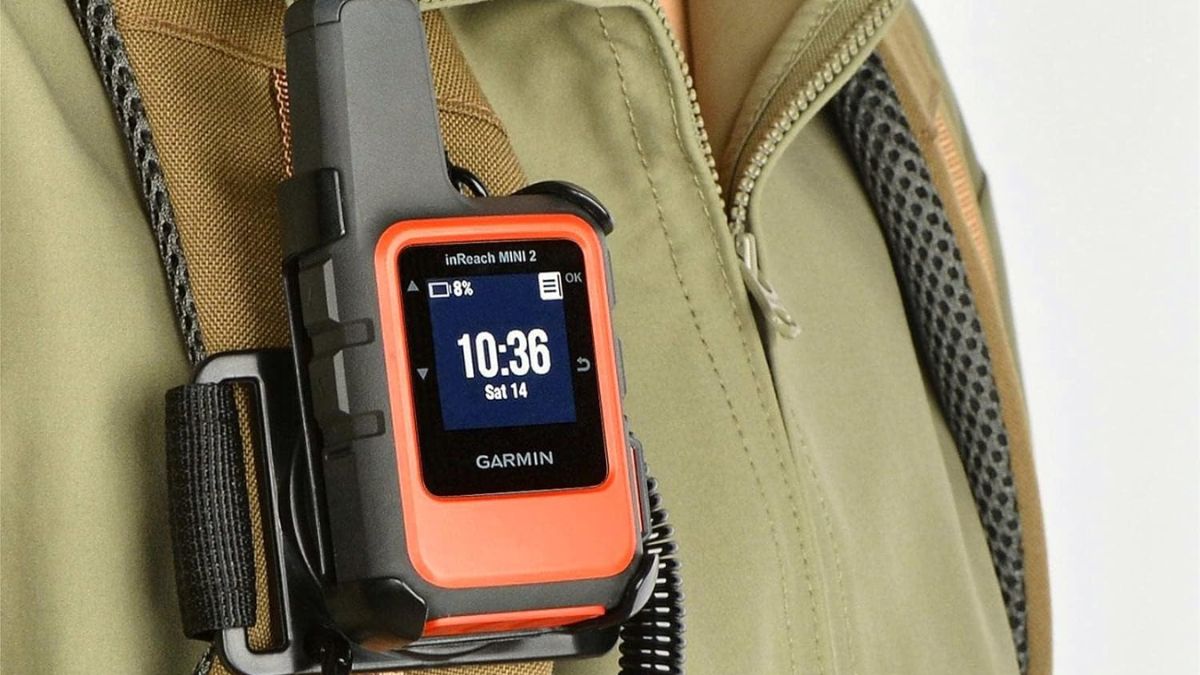
- A satellite messenger (like the Garmin inReach Mini 2) connects to a private satellite network (Iridium) and allows two-way text communication plus SOS functionality. You can message rescue services AND your emergency contacts. The trade-off? Monthly subscription required, and you need a separate waterproof housing for diving use.
| Feature | True PLB (ACR, Ocean Signal) | AIS Transponder (Nautilus) | Satellite Messenger (Garmin inReach) |
|---|---|---|---|
| Signal reaches | Government SAR via satellite | Nearby AIS-equipped vessels | Private rescue center + contacts |
| Range | Global (satellite) | Up to 34 miles (line of sight) | Global (satellite) |
| Two-way communication | No (one-way distress only) | No (one-way distress only) | Yes (text messaging) |
| Subscription | None | None | ~$15/month minimum |
| Depth rating | Surface only (needs canister) | 130m (425ft) built-in | Surface only (needs dive case) |
| Battery life | 24-28 hrs active / 5-7 yrs standby | 5 years (replaceable) | ~30 days tracking / rechargeable |
| Buoyant | Yes (most models) | Yes | No (sinks without case) |
| Price range | $250-$400 | $250-$300 | $350-$400 + subscription |
| Best for | Remote/expedition diving | Boat diving, drift diving | Multi-activity (dive + hike + sail) |
Three devices, three different systems, three different use cases. Knowing which category you need is more important than which brand you pick.
How Does a Personal Locator Beacon Work?
When you activate a true PLB, it does several things simultaneously. First, it acquires your GPS position. Then it broadcasts a distress signal on the internationally recognized 406 MHz emergency frequency. This signal is picked up by COSPAS-SARSAT satellites orbiting Earth. There are roughly 66 of them up there, so coverage is genuinely global.
The satellite relays your signal, including your GPS coordinates and your unique beacon ID, to the nearest Rescue Coordination Center. That center contacts the search and rescue authority closest to your position. They dispatch assets: coast guard vessels, helicopters, nearby ships. Meanwhile, your PLB also transmits a 121.5 MHz homing signal. This is a shorter-range radio frequency that rescue teams use for the final approach, essentially zeroing in on your exact position once they’re in the area.
Did you know? The COSPAS-SARSAT system has helped rescue over 60,000 people worldwide since 1982. The service is funded by participating governments and is completely free to use. No registration fee, no activation fee, no subscription. Your tax dollars at work, quite literally saving lives.
Let me set realistic expectations for you on response time. Marketing materials love to imply instant rescue. The reality depends heavily on where you are. In US coastal waters with active Coast Guard stations, response can be impressively fast, sometimes under 30 minutes. In remote areas of the Pacific, including where we dive in Costa Rica, response times can be significantly longer. Having your GPS coordinates narrows the search area from “somewhere in the ocean” to “within 100 meters of this point.” That’s the real value. Not instant rescue, but dramatically faster rescue.
A PLB puts you on the map, literally. What happens after that depends on where you are and who’s coming to get you.
Which Rescue Device Is Right for Your Type of Diving?
Here’s where I’m going to be more direct than most articles on this topic. Not every diver needs a personal locator beacon. There, I said it. If that surprises you coming from someone who runs a dive center, good. It means I’m being honest with you rather than trying to sell you something.
If you do organized shore dives or boat dives with a reputable operator that has proper safety equipment, your risk of being lost at sea is extremely low. The boat has an EPIRB (Emergency Position Indicating Radio Beacon, a vessel-mounted version of a PLB). The captain has VHF radio. The crew counts heads. Your dive guide carries a surface marker buoy. You’re covered by multiple layers of safety that don’t require you to carry your own device.
Match the PLB to the conditions
Where a personal rescue device becomes genuinely important is when those layers thin out. Drift diving in strong currents where separation from the boat is a real possibility. Open ocean diving where the pickup point is far from shore. Remote liveaboard trips to places like Cocos Island, Malpelo, or the Galapagos, where the nearest coast guard station might be hours away. Solo diving or buddy-pair diving without a dedicated surface watch. Any scenario where you might surface and the boat might not be right there.
For those situations, here’s my honest recommendation by diving scenario. If you primarily do boat diving in areas with regular vessel traffic (Caribbean, Florida, Red Sea, Malta and Gozo, Southeast Asia), an AIS transponder like the Nautilus gives you the fastest response because it talks directly to nearby boats.
If you dive in truly remote locations with minimal vessel traffic, a true satellite PLB is your better bet because it doesn’t depend on anyone being nearby. And if you’re someone who dives, hikes, sails, and generally spends time in remote places, the Garmin inReach gives you the most versatility across all your activities.
Match the device to your actual diving, not to your worst-case fantasy. That’s how you make a smart safety investment.
Best Personal Locator Beacons and Rescue Devices for Divers
Nautilus Marine Rescue GPS
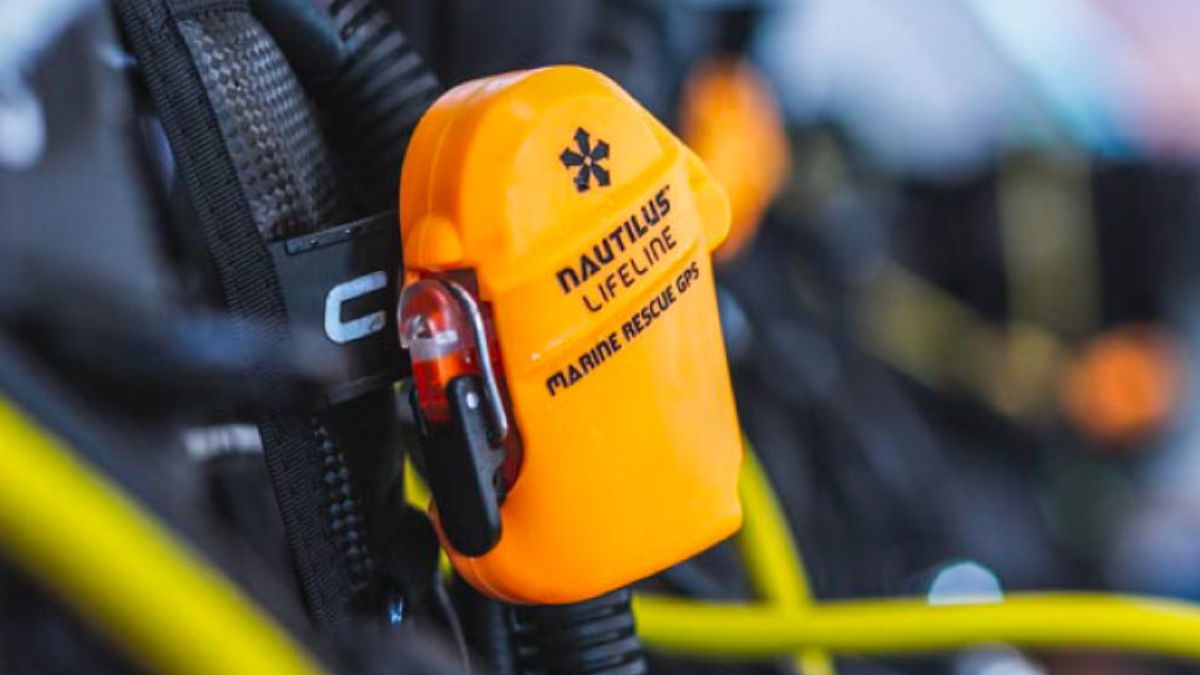
The Nautilus is the device I see most often on dive boats, and for good reason. It’s purpose-built for divers. Depth-rated to 130 meters. Positively buoyant, so if you drop it, it floats back up (a feature you’ll appreciate more than you think). Battery lasts 5 years with user-replaceable cells. No subscription, no registration hassle, no recurring costs.
When you press the button, it sends a digital distress signal with your GPS coordinates via AIS and DSC (Digital Selective Calling) to every equipped vessel within range, up to 34 miles in optimal conditions. The signal hits your dive boat’s chartplotter immediately. It also reaches coast guard stations and commercial vessels monitoring AIS. The response is fast because the message goes straight to the boats that can actually come get you.
The limitation? AIS is line-of-sight technology. If you’re far from any vessel or coastal station, the range drops. For diving off Uvita or Caño Island where we operate, this is perfectly adequate because there’s always vessel traffic in the area. For a truly remote expedition, you’d want satellite backup.
ACR ResQLink View
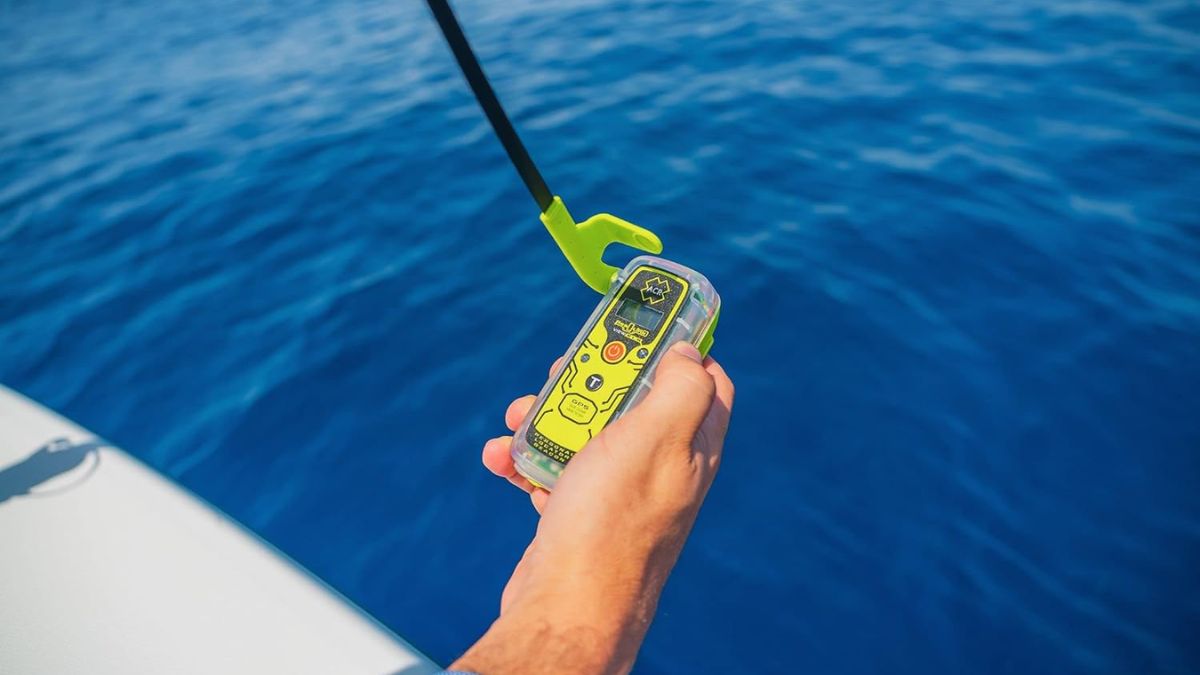
The ACR ResQLink View is a true PLB that transmits to the COSPAS-SARSAT satellite network. It’s compact, buoyant, and has a built-in digital display that shows your GPS coordinates and confirms when your signal has been received (this feature is called Return Link Service, and it’s a genuine comfort when you’re floating alone waiting for help).
It transmits for up to 28 hours on a single battery charge, with a 5-year battery life between replacements. No subscription required. You register it once with your national authority (free in most countries), and it’s ready to go. GPS accuracy is typically within 100 meters.
For divers, the catch is that the ResQLink is surface-rated only. You need a dive canister to carry it underwater. Companies like Custom Divers, DRYFOB, and WICKED make purpose-built canisters that clip to your BCD and protect the PLB from pressure and saltwater. Budget an extra $50-$100 for a quality canister.
Fun fact: The ACR ResQLink View uses three satellite constellations simultaneously: GPS, Galileo, and GLONASS. This multi-constellation approach means faster position fixes and better accuracy, especially in challenging conditions where one system alone might struggle to lock on.
Ocean Signal RescueME PLB1
The RescueME PLB1 holds the title of smallest and lightest true PLB on the market. It’s about the size of a chunky lighter. If space and weight matter to you (and they should, because BCD pockets aren’t bottomless), this device is hard to beat on pure portability.
It works on the same COSPAS-SARSAT system as the ACR, transmitting at 406 MHz with built-in GPS. Battery lasts over 24 hours when activated, with a 7-year standby life. It includes a strobe light and 121.5 MHz homing beacon for final-approach location. Like the ACR, it needs a dive canister for underwater transport.
One detail worth noting: the RescueME PLB1 does not have the Return Link Service found on the ACR ResQLink View. That means you won’t get confirmation that your signal was received. You activate it and trust the system. The system works, but the psychological difference of seeing a “message received” confirmation on the ACR’s screen is real. If you’re the type who needs that reassurance (and I don’t blame you), the ACR might be worth the slight size increase.
Garmin inReach Mini 2
The Garmin inReach Mini 2 is technically not a PLB. It’s a satellite messenger that connects to the private Iridium satellite network. I include it here because many divers consider it alongside traditional PLBs, and for multi-activity adventurers, it offers capabilities the others simply can’t match.
The standout feature is two-way communication. You can send and receive text messages via satellite, anywhere on Earth. When you trigger the SOS, you’re connected to Garmin’s International Emergency Response Coordination Center, where a real person coordinates your rescue and can text you updates. That back-and-forth communication is a game-changer compared to the one-way “hope they got my signal” experience of a traditional PLB.
The trade-offs: you need a monthly subscription ($14.95/month minimum plan). For diving, you need an optional underwater housing rated to 100 meters (about $80-$100 extra). The battery is rechargeable via USB, lasting about 30 days in tracking mode, but obviously less with heavy messaging use. It’s the most expensive option when you factor in the ongoing subscription cost.
Each device excels in a different scenario. The Nautilus wins on speed and simplicity for boat diving. The ACR and Ocean Signal win on global reach for remote expeditions. The Garmin wins on versatility and communication for multi-sport adventurers.
Do You Need a Dive Canister for Your PLB?
If you’re carrying a true PLB or a Garmin inReach underwater, yes. These devices are surface-rated electronics. Subjecting them to dive pressure without protection will damage or destroy them. A dive canister is a pressure-rated housing that protects your device during the dive and allows quick access when you surface.
The Nautilus is the exception here. It’s built diver-tough with a 130-meter depth rating. No canister needed. You clip it to your BCD, dive, surface, open the dive cap, and hit the button. This simplicity is one of the biggest practical advantages of the Nautilus for recreational divers.
Secure your PLB device
For PLBs that need canisters, you have several good options. Custom Divers (UK-based) makes lightweight aluminum canisters that fit most PLB models and clip easily to a BCD D-ring. DRYFOB (US-based) offers robust canisters popular with liveaboard divers. WICKED Dive Canisters specializes in housings compatible with technical diving setups. Prices range from $50 to $150 depending on material and depth rating.
Here’s something I tell every diver who buys a canister: practice the deployment before you need it. In a pool, in your backyard, wherever. Open the canister, pull out the device, extend the antenna, activate it (without actually transmitting, obviously). Do it with gloves on. Do it with one hand. Time yourself. In a real emergency, with adrenaline pumping and waves slapping your face, fine motor skills deteriorate fast. The deployment should be muscle memory, not a puzzle you’re solving for the first time.
A PLB in a canister you can’t open quickly is just expensive ballast. Practice the deployment until it’s boring.
How to Register and Maintain Your PLB
Every true PLB must be registered before use. In the United States, registration is free through NOAA’s beacon registration database. Most countries have their own registration system. The process takes about ten minutes online. You’ll provide your name, emergency contacts, a description of your planned activities, and any relevant medical information. This data is what rescue coordinators see when your signal comes in. Keeping it current is critical.
If you change your phone number, emergency contact, or primary activity, update your registration. Outdated contact info slows down the verification process and can delay rescue response. I’ve heard stories of rescue coordination centers calling registered emergency contacts only to reach disconnected numbers. Don’t be that person.
One more thing that’s important to know: activating a PLB when no emergency exists is a criminal offense in many countries. False alerts waste massive resources and can divert rescue assets from real emergencies. Test your device only using the built-in self-test function, never by fully activating it.
Did you know? You can take a PLB on commercial flights. The Ocean Signal RescueME PLB1 and ACR ResQLink both comply with IATA Dangerous Goods Regulations for carry-on and checked luggage. The lithium battery contains less than 2g of lithium, well under the airline limit. Just make sure the device is protected against accidental activation in your bag.
Register, keep your info current, check the battery date. Three simple habits that make the difference between a device that saves you and one that fails you.
Frequently Asked Questions
Can I use a personal locator beacon underwater?
No. PLBs are surface-only devices because radio signals cannot penetrate water to reach satellites. You carry the device underwater in a protective dive canister or (in the case of the Nautilus) clipped directly to your BCD with the dive cap closed. You deploy and activate it only after surfacing. The antenna must be above water and extended for the signal to transmit.
How long does rescue take after activating a PLB?
It varies enormously based on your location. In well-patrolled coastal waters with nearby coast guard stations, rescue can arrive within 30 minutes to 2 hours. In remote ocean areas, it can take considerably longer. AIS-based devices like the Nautilus tend to produce faster local response because nearby vessels receive your position immediately. Satellite PLBs provide broader coverage but involve more relay steps before rescue is dispatched. Plan for hours, not minutes.
Do I need a subscription for a PLB?
True PLBs (ACR ResQLink, Ocean Signal RescueME) and AIS transponders (Nautilus) require no subscription. The COSPAS-SARSAT satellite system is government-funded and free to use. Registration is also free in most countries. The Garmin inReach Mini 2 is the exception. It requires a minimum monthly plan of about $15 to access the Iridium satellite network for messaging and SOS functions.
What is the range of a Nautilus Marine Rescue GPS?
The Nautilus transmits via AIS with a maximum range of approximately 34 miles (about 55 km) under optimal conditions. In practice, range depends on antenna height of receiving vessels, weather, and sea conditions. For typical dive boat operations within 10-20 miles of shore, the Nautilus provides reliable coverage. For true open-ocean scenarios far from any vessel traffic, a satellite-based PLB offers more dependable range.
Can I take a PLB on an airplane?
Yes. Both the ACR ResQLink and Ocean Signal RescueME PLB1 are approved for carry-on and checked luggage under IATA regulations. The lithium batteries in these devices are well under the size limits for air transport. Protect the device against accidental activation by keeping it in its protective case or pouch. The Garmin inReach Mini 2 is also flight-safe as a standard lithium battery device.
Is a PLB worth it for recreational divers?
That depends on where and how you dive. For organized shore dives and boat dives with reputable operators in busy coastal areas, a PLB is a nice-to-have but not essential. For drift diving, open-ocean diving, liveaboard trips, or diving in areas with limited rescue infrastructure, a PLB is a genuinely smart investment. Think of it like dive insurance: you hope you never use it, but when you need it, nothing else will do.
What happens if I accidentally activate my PLB?
Turn it off immediately and contact your national rescue coordination center to report the false alert. In the US, call the Air Force Rescue Coordination Center. Most countries have a similar authority. False alerts are taken seriously. Intentional false activation is a criminal offense in many jurisdictions and can result in fines. Accidental activations do happen, and authorities are understanding when you report them promptly. What they don’t appreciate is unreported false alerts that waste rescue resources.
Do I need a PLB if I already carry a DSMB?
A delayed surface marker buoy and a PLB serve completely different functions. Your DSMB is a visual signal that helps the boat locate you from a moderate distance. It works brilliantly in normal conditions when the boat is looking for you in roughly the right area. A PLB is for when the boat has no idea where you are, or when you’ve drifted far beyond visual range, or when conditions prevent the boat from reaching you. They complement each other perfectly. If I had to choose just one, I’d pick the DSMB for everyday diving and add the PLB for high-risk scenarios.
The Safety Net You Hope You Never Need
Imagine this: you surface after a beautiful dive at Caño Island. The current pushed you further than expected. You inflate your DSMB and scan the horizon. The boat isn’t where it should be. For a moment, your heart rate spikes. Then you reach down, unclip the device from your BCD, extend the antenna, and press the button. A green light blinks. Your coordinates are on their way. You float, you wait, and within minutes you hear the engine. The captain already has your position on screen.
That calm, that confidence, is what a rescue device gives you. Not a guarantee. Not a magic wand. Just the quiet knowledge that if something goes wrong on the surface, you have a way to be found.
Related Resources
Safety & Skills:
Gear & Equipment:
Destinations & Courses:
- How to Get Scuba Certified in Costa Rica
- Diving at Night. A complete guide to night diving.
- Diving with sharks – Everything You Want to Know