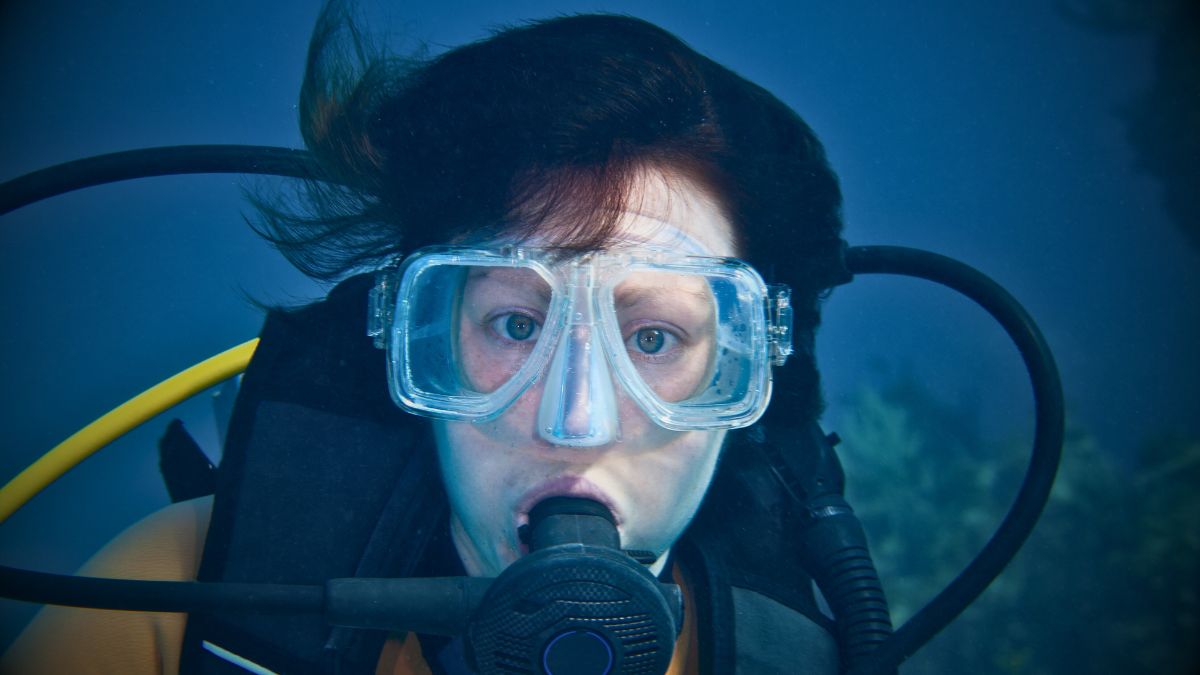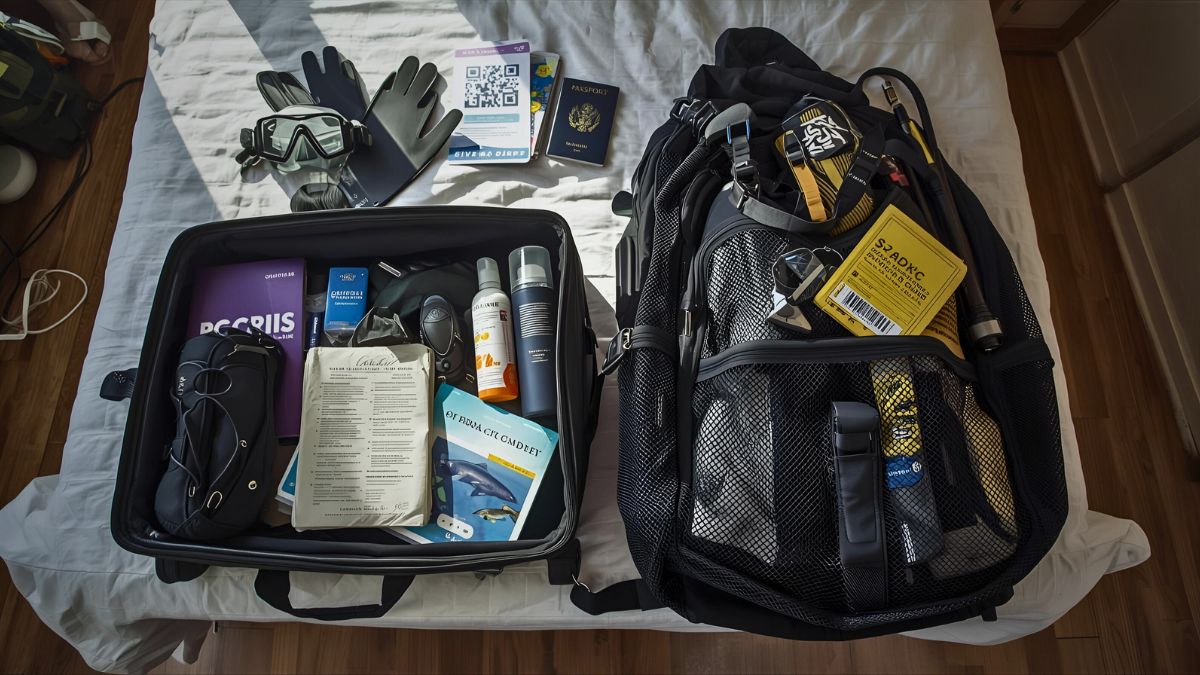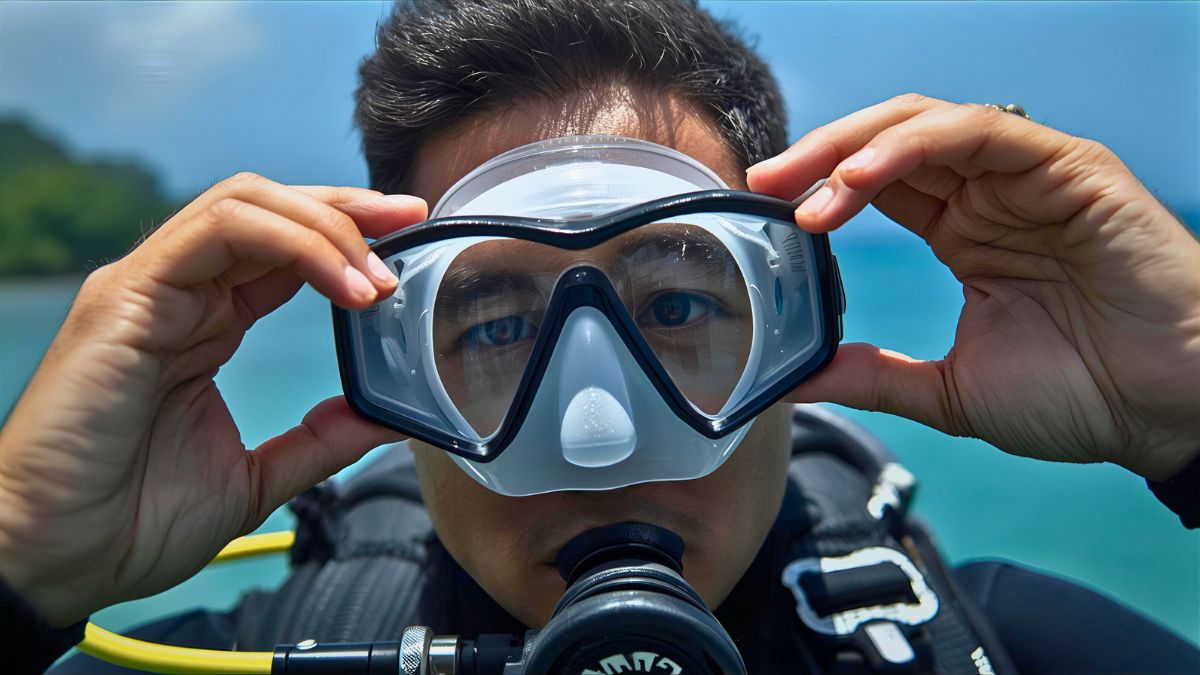
I remember the exact dive that made me want to go further. It was a wreck somewhere in the Mediterranean, and I was hovering at 38 meters watching the rest of the hull disappear into deeper water. Everything interesting was below me. Everything I was certified to do kept me right where I was. I turned around, ascended, and spent the surface interval thinking about it.
That gap between where recreational diving ends and where the interesting things start is exactly what technical diving was built to close. If you’ve ever hovered at your depth limit watching something go deeper and felt that pull, this article is for you.
I’m not going to sell you on tec diving. I’m going to tell you what it actually is, what it demands, and how to decide whether the path is right for you. Some people read this and go sign up for their first course. Others read it and realize they’re not there yet. Both outcomes are fine.
What Separates Technical Diving from Recreational Diving
The standard answer is depth: recreational divers go to 40 meters, tec divers go deeper. That’s true, but it misses the real distinction.
The actual boundary is the concept of the overhead environment. In recreational diving, you always have direct access to the surface. If something goes wrong, you ascend. It’s not always simple, but the option exists. Technical diving removes that option in one of two ways.
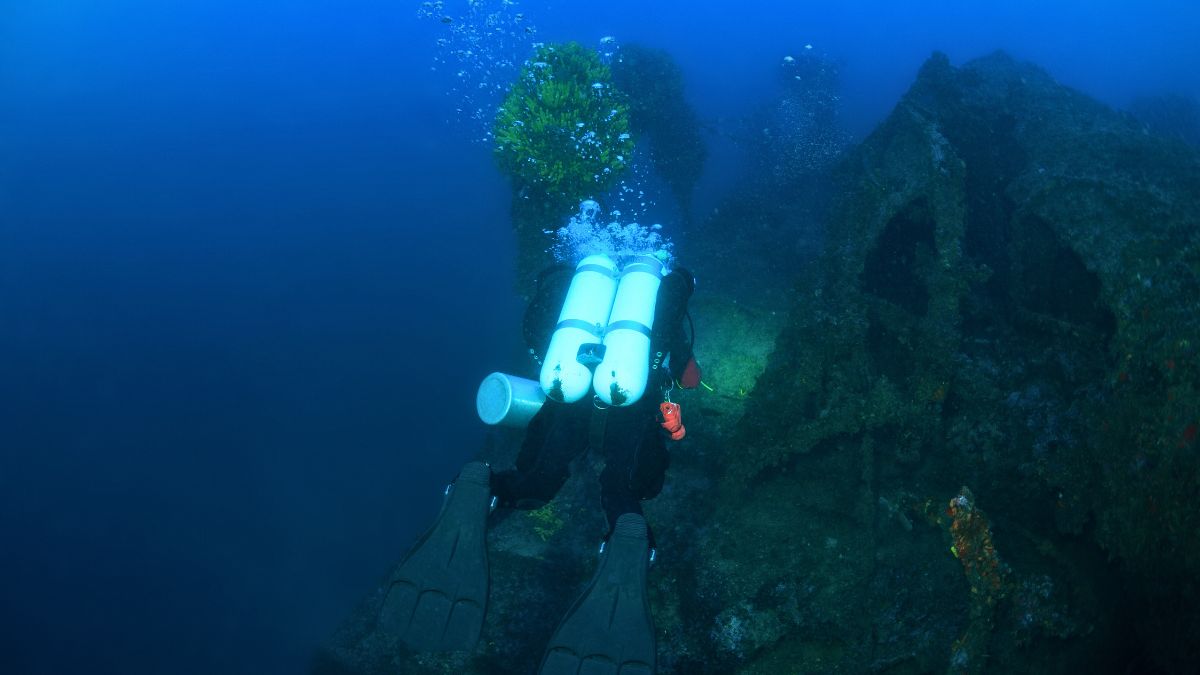
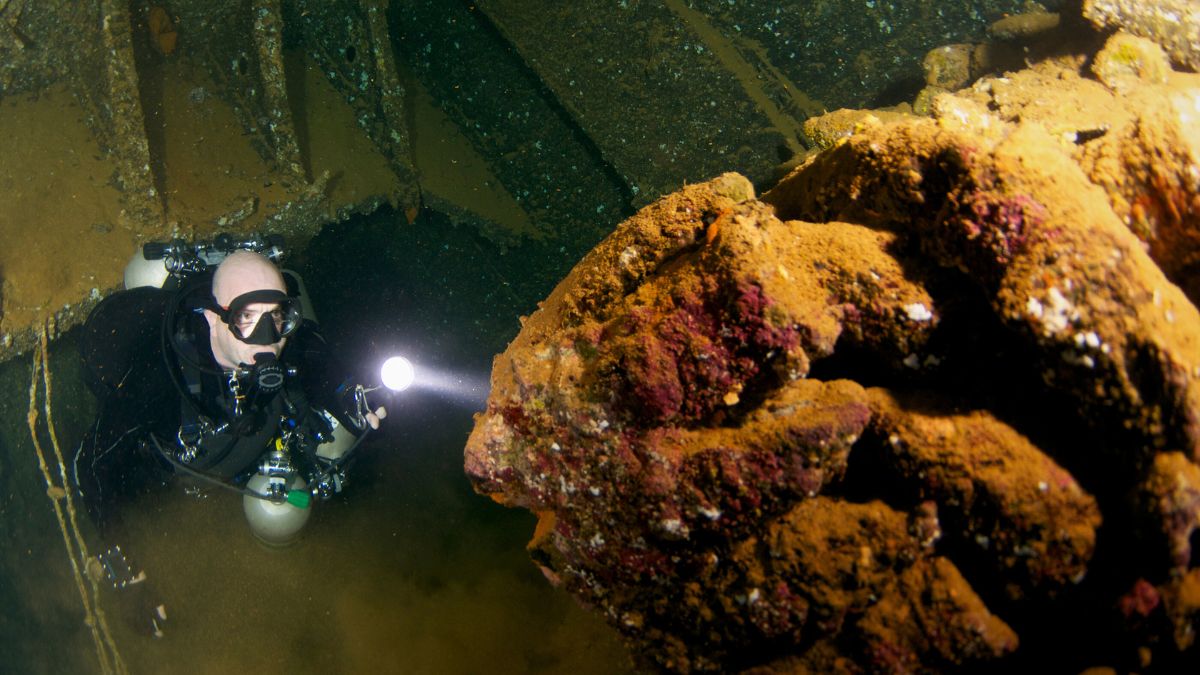
The first is a physical overhead: a cave ceiling, the inside of a wreck, a cavern passage. You cannot ascend through rock or steel. Your exit requires following the same path back out, managing your gas supply and team along the way.
You are exceeding the no-decompression limits
The second is a physiological overhead: a decompression obligation. When you dive deep enough for long enough, nitrogen saturates your body tissues faster than your body can safely eliminate it on a direct ascent. You now owe your body a series of decompression stops at specific depths before you can surface. Skip them and you risk decompression sickness. The depth and the water above you aren’t blocking you, but your own physiology is.
Recreational divers manage this by staying within no-decompression limits (NDL). Your dive computer calculates how long you can stay at a given depth before incurring a deco obligation. Stay within those limits, ascend with a 3-minute safety stop at 5 meters, and you’re fine. Technical diving deliberately crosses those limits, which is why it requires a completely different level of planning, equipment, and training.
Did you know? The term “technical diving” was first used in the early 1990s by aquatic writer Michael Menduno in his magazine aquaCORPS. Before that, divers pushing beyond recreational limits had no common name for what they were doing.
Why Do Divers Go Tec? The Real Motivations
I’ve asked this question to every student who’s come to me about tec training, and the honest answers fall into a few patterns.
Some want a specific site. There’s a wreck at 65 meters they’ve read about for years. There’s a cave system whose deepest passages are impossible without deco training. The motivation is concrete and directional, and in my experience, these divers do well. They know exactly why the work is worth it.
Some are drawn to the discipline itself. Technical diving demands a precision that recreational diving rarely does. Every gas consumption rate calculated. Every emergency scenario pre-briefed. Every problem solved before it happens. For certain kinds of minds, this rigor is the reward, not just a means to an end.
More gear, more training, more rules
Some want to be better recreational divers. Tec training, particularly the early stages, forces you to confront every weakness in your fundamentals: your buoyancy, your trim, your reaction under pressure. Divers who go through a TEC 40 course and decide tec isn’t for them still emerge as significantly better recreational divers. The training is worth it either way.
And then there are the ones who want to go deep because it sounds impressive. I tell them directly: this is not a good enough reason. Technical diving carries real risk, and that risk needs to be justified by genuine motivation. If the goal is a depth number on a dive log, tec diving will not give you what you’re looking for.
Are You Ready for Technical Diving? An Honest Self-Assessment
This is the part most articles skip, and it’s the most important part. Your certification card gets you into a course. Your skills determine whether you succeed and stay safe.
- Buoyancy and trim. Can you hold a precise depth of 6 meters for 3 minutes without moving your hands, while staying fully horizontal? Not approximately horizontal. Horizontal. In a tec course, decompression stops happen at exact depths with equipment significantly heavier than a recreational rig. If your buoyancy control needs active management in recreational diving, tec training will expose that immediately.
- Propulsion techniques. Do you have a frog kick? Can you back-kick to move away from a wall without turning around? Can you do a modified flutter kick that generates zero silt disturbance? In overhead environments, poor finning technique doesn’t just affect your visibility. It affects the visibility of your entire team for the rest of the dive.
- Stress management. Think about the last time something went wrong on a dive. A free-flowing regulator, a mask flood, an unexpected current. What did you do? If your instinct is to ascend, that’s a reasonable recreational response. In a tec context, ascending is sometimes not an option. The ability to slow down, work the problem, and communicate with your team while remaining at depth is a skill that has to be built before the course, not during it.
- Dive planning. When you show up at a dive site, do you plan the dive or do you follow the guide? Tec divers plan their own dives in detail: maximum depth, bottom time, turn pressure, gas switches, decompression schedule, abort criteria, emergency procedures. If you’ve never written a dive plan, start practicing before your first tec course.
- Experience base. Most entry-level tec courses require 30-100 logged dives depending on the agency. The number is the minimum, not the target. A diver with 30 dives who started yesterday has a very different experience base from a diver with 30 dives accumulated over two years of varied diving. The quality and variety of your diving matters more than the number.
If you read this list and feel genuinely confident in all five areas, you’re probably ready to explore your first tec course. If two or three of them gave you pause, that’s good information. Work on those areas in recreational diving first. Your tec instructor will thank you, and more importantly, your future diving partner will thank you.
Technical Diving Courses: The Main Pathways
There is no single governing body for technical diving. Several agencies offer tec training, each with a different philosophy and course structure. All major agency certifications are recognized by dive centers worldwide, and crossover between agencies is common. Here’s what each path looks like.
PADI TecRec
The most recognized name in recreational diving offers a structured tec pathway starting with the TEC 40 course. This is the entry point: decompression dives to 40 meters with no more than 10 minutes of total decompression time, one stage cylinder, and oxygen up to 50% as a deco gas. Prerequisites include PADI Advanced Open Water, Enriched Air Diver certification, Deep Diver specialty or proof of 10 dives below 30 meters, at least 30 logged dives, minimum age of 18, and a physician-signed medical form dated within the last 12 months.
From TEC 40 the path continues to TEC 45 (45m, multiple deco stops, pure oxygen option), then TEC 50 (50m, two deco gases), and eventually to the trimix courses. TEC TRIMIX 65 introduces helium into the breathing mix, which reduces narcosis at depth and makes thinking clearer below 50 meters. The pinnacle of the PADI open-circuit tec path is TEC TRIMIX DIVER, which qualifies you to dive to 90 meters with up to four stage cylinders.
TDI (Technical Diving International)
TDI is the world’s largest dedicated technical diving agency, and it operates differently from PADI. Where PADI builds a structured course ladder, TDI focuses more on performance standards and real-world application. The entry path combines Advanced Nitrox with Decompression Procedures, giving you a solid theoretical foundation before you go deep. From there: Extended Range, Trimix, Advanced Trimix to 100 meters.
TDI has a strong reputation in wreck diving and cave diving communities. If you see yourself eventually doing penetration wreck dives or cave diving, TDI’s community and philosophy may be a better fit than PADI’s more structured approach. Many experienced tec instructors hold TDI certifications alongside or instead of PADI’s.
SSI Extended Range
SSI’s technical pathway begins with Extended Range, which trains you to dive to 40 meters with up to 25 minutes of decompression time. Prerequisites are stricter than PADI’s entry level: at least 70 logged dives, with 20 dives deeper than 30 meters and 10 with required decompression stops. This means SSI assumes you already have meaningful experience at depth before starting formal tec training.
From Extended Range, the SSI path continues to Extended Range Trimix and eventually Hypoxic Trimix, qualifying you for dives to 100 meters. SSI is particularly strong in Europe, and its experience requirements between course levels are notably higher than other agencies.
GUE (Global Underwater Explorers)
GUE operates differently from every other diving agency. It uses standardized equipment configurations across all its divers, requires a non-smoking commitment, and emphasizes team diving to a degree that other agencies don’t match. Before any technical training, you must complete GUE Fundamentals, a course focused entirely on foundational skills that most recreational divers have never formally addressed.
GUE Technical Diver Level 1 requires a minimum of 100 logged dives, and the course itself runs a minimum of six days. It is demanding. It is also widely considered to produce the most consistently capable tec divers. If you want the most rigorous possible training and are serious about deep exploration, GUE is worth researching seriously.
| Agency | Entry Course | Max Depth (Entry) | Min Dives Required | Best For |
|---|---|---|---|---|
| PADI TecRec | TEC 40 | 40m | 30 | Divers already in PADI system; structured progression |
| TDI | Adv Nitrox + Deco Procedures | 45m | 25+ | Wreck and cave community; performance-focused |
| SSI Extended Range | Extended Range | 40m | 70 | Divers with solid experience base; strong in Europe |
| GUE | Tech 1 (after Fundamentals) | 51m | 100 | Serious tec divers; standardized team diving |
Technical Diving Equipment: What Changes and Why
Tec divers don’t use different gear because it looks more serious. Every piece of equipment exists because a specific failure mode at depth could be fatal, and redundancy is how you survive it.
- Twin cylinders. A recreational diver with a single tank has one gas supply. If the tank valve fails or the regulator fails catastrophically, the dive is over. At 10 meters, you ascend. At 60 meters in an overhead environment, you cannot. Twin cylinders give you two independent gas supplies connected by an isolator manifold. If one regulator fails, you close that side and breathe from the other. Redundancy is the reason, not aesthetics.
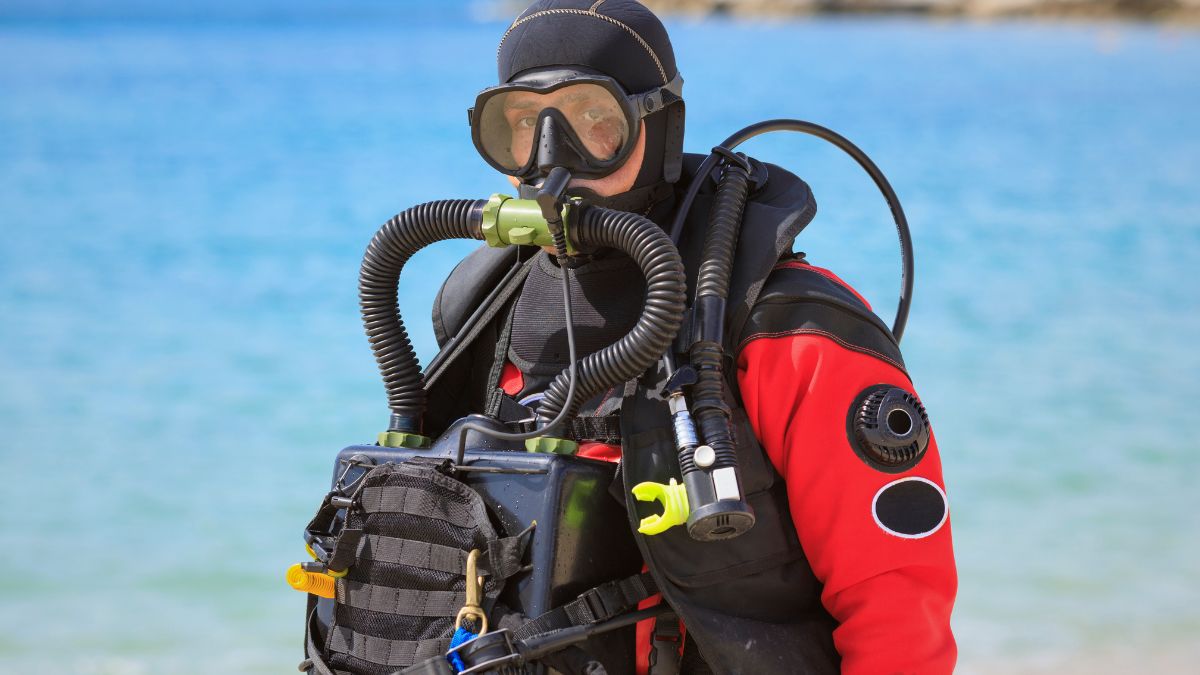
- Rebreathers. Classic open circuit diving exhausts each breath into the water as bubbles. A rebreather recirculates your exhaled gas, scrubs out the carbon dioxide, and adds only the oxygen your body actually consumed. The result is dramatically longer dive times, no bubbles (which matters enormously for wildlife photography and military diving), and significantly reduced gas costs on long or deep dives.
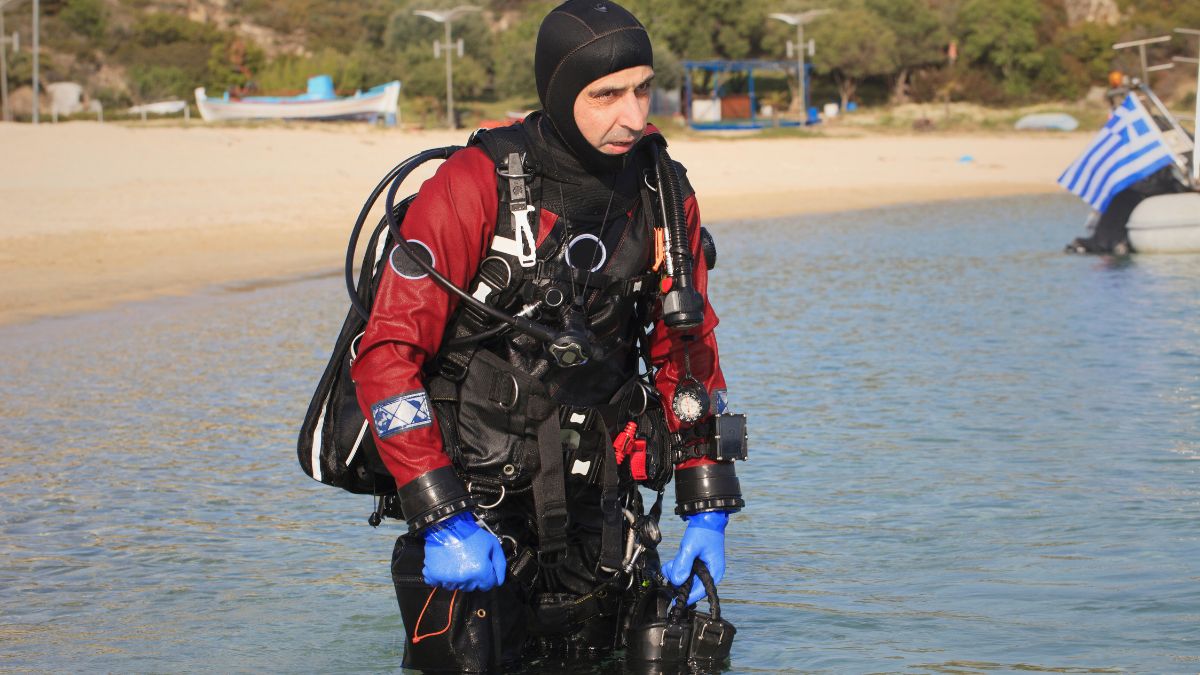
- Drysuit. Most recreational divers get by with a wetsuit, but technical diving often takes you into conditions where a wetsuit isn’t enough. Deeper dives are colder dives: water temperature drops significantly below the thermocline, and a long decompression ceiling means spending 30 to 60 minutes ascending slowly through cold water, not swimming to warm up. A drysuit keeps you dry by sealing air inside the suit, which you add and release to manage buoyancy alongside your BCD.
- Backmount vs sidemount. In a backmount configuration, twin cylinders ride on your back like an oversized recreational tank. This is the standard tec setup for most open-water technical diving. Sidemount mounts each cylinder on the side of your body, reducing your vertical profile and giving easier access to tank valves. Sidemount originated in cave diving, where squeezing through narrow restrictions is sometimes necessary, and has since become popular in all forms of tec diving.
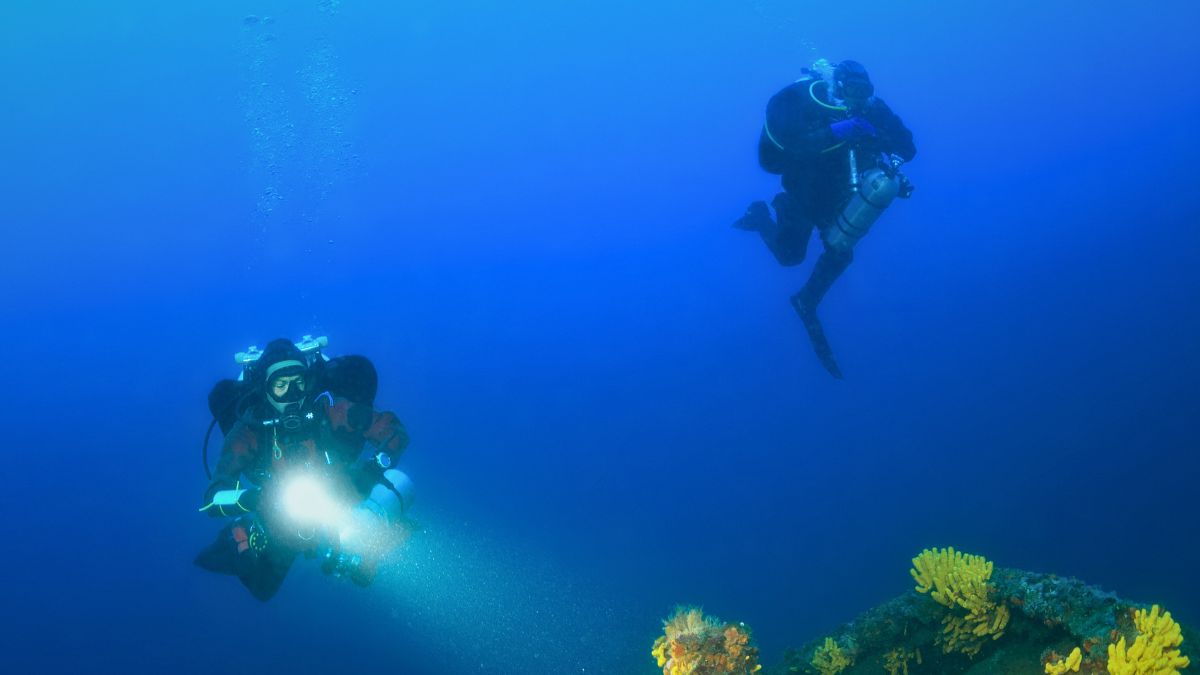
- Stage and deco cylinders. For deeper dives with multiple decompression stops, you carry additional cylinders on your sides. These contain different gas mixes for different phases of the dive. A typical deep tec setup might include twin back-mounted cylinders with bottom mix (trimix), plus one or two stage cylinders containing nitrox for mid-depth deco stops, plus a pure oxygen cylinder for final shallow stops. You breathe the right gas at the right depth and switch at planned points.
- Wing BCD vs jacket BCD. Recreational BCDs are designed to keep you upright at the surface. Tec divers need horizontal trim underwater. A wing BCD with a backplate inflates behind your back and keeps you neutral in a horizontal position. The backplate also distributes the weight of twin cylinders more evenly than a jacket BCD can manage.
- Long hose configuration. Tec divers route their primary second stage on a long hose of about 2 meters, coiled under the right arm. In an out-of-gas emergency in an overhead environment, you donate your long-hose regulator to your buddy and switch to the short-hose backup on your neck. Single file passage through tight restrictions becomes possible with this setup. It’s a standard you’ll learn in any serious tec course.
- Decompression computers. Recreational computers track depth and time against a pre-loaded algorithm. Tec computers manage multiple gases, calculate decompression schedules dynamically as the dive evolves, and allow input of different breathing mixes for different dive phases. Most experienced tec divers also use desktop decompression planning software before the dive to generate a planned schedule, then cross-check with their wrist computer underwater.
Understanding Decompression: The Core Concept
You don’t need to understand the mathematics of decompression to become a tec diver. You do need to understand what’s actually happening in your body and why decompression stops are not optional.
When you breathe compressed gas at depth, the increased partial pressure of nitrogen causes it to dissolve into your blood and body tissues. The deeper you go and the longer you stay, the more nitrogen saturates your tissues. This is normal and manageable, as long as you ascend slowly enough to let your body eliminate the nitrogen gradually.
Your no-decompression limit is the point at which your tissues have absorbed enough nitrogen that a direct ascent, even with a safety stop, is no longer safe. Cross that line and you have a decompression obligation. You must ascend in stages, pausing at specific depths for specific periods to allow controlled off-gassing. Skip those stops and the nitrogen that should have dissolved safely can form bubbles in your tissues and bloodstream. This is decompression sickness, and the consequences range from joint pain to neurological damage to death.
Fun fact: The long hose configuration used by most tec divers today was standardized by cave divers in Florida in the 1980s. It emerged from real emergencies in overhead environments and became the accepted solution for gas sharing at depth.
Tec divers plan their decompression schedules before the dive using software like DECO Planner or Subsurface. They input their planned maximum depth, bottom time, and gas mixes, and the software generates a decompression schedule: stop at 21 meters for 3 minutes, 18 meters for 5 minutes, 15 meters for 8 minutes, and so on up to a final oxygen stop at 6 meters. That schedule is then executed precisely underwater, with the tec computer providing real-time guidance.
The reason this matters when deciding whether to pursue tec diving is straightforward: a recreational diver who makes a mistake can usually ascend and fix it. A tec diver in decompression cannot. The obligation is already incurred. The only path is to complete the stops correctly, manage whatever problem arose, and surface safely. That requires a different quality of preparation from anything recreational diving demands.
What Technical Diving Actually Costs
This is the honest conversation most articles avoid. Technical diving is expensive, and not just the courses.
A PADI TEC 40 course typically runs between $500 and $800 depending on the instructor and location. That gets you certified to 40 meters with limited decompression. The courses above it are similarly priced, so completing the full PADI tec ladder through Tec Trimix Diver represents a training investment of $3,000-5,000 or more, spread over several years.
The equipment cost is where it gets serious. A complete tec diving setup including twin cylinders, wing and backplate, two or three regulators, a stage cylinder, and a tec dive computer runs $4,000-10,000 new. You can reduce this significantly by buying used gear from reputable sources, but tec equipment should always be inspected and serviced before use.
Ongoing costs include gas fills (nitrox and trimix cost more than compressed air), regular equipment service, and travel to suitable tec dive sites. None of this is meant to discourage you. It’s meant to help you plan honestly. Tec diving is a long-term commitment of time, money, and focused effort. Start building your skills now, save deliberately, and take the first course when you’re genuinely ready rather than just impatient.
The Mindset That Actually Makes a Tec Diver
I’ve watched students with perfect buoyancy and excellent trim struggle in tec training. I’ve also watched students who were below average technically but had the right mindset and went on to become excellent technical divers. The gear and the certification matter, but the mindset is what separates the divers who stay safe from those who don’t.
- Discipline over improvisation. Recreational diving has room for flexibility. Technical diving plans are not suggestions. Maximum depth, turn pressure, gas switch points, abort criteria: these are decided before you enter the water and executed as decided. Improvising a decompression schedule at 50 meters because the dive didn’t go as planned is how divers get hurt.
- Redundancy thinking. Technical divers don’t just carry backup equipment. They think in backups. What if this regulator free-flows? What if my computer fails at the first deco stop? What if my buddy signals abort halfway through the dive? Every scenario is pre-briefed. The decision is already made before the situation arises.
- Team diving. Technical diving is not a solo activity. Your diving partner is part of your life-support system. If you run low on gas, they have enough to get both of you to the surface safely. That trust requires diving together regularly, knowing each other’s equipment, and communicating clearly underwater. Showing up to a tec dive with a stranger as your buddy is not how this works.
- Ego management. The ability to abort a dive without it meaning something about you as a diver is a genuine skill. Equipment feels wrong. Conditions aren’t right. You’re not in the right headspace. In tec diving, any of these is a sufficient reason to call the dive before entry. The divers who make the most progress in tec training are the ones who can do this without embarrassment.
The divers who struggle in tec courses usually aren’t the ones who lack physical skills. They’re the ones who can’t slow down. They push past problems they should pause for. They skip steps in the planning process. They let the excitement of the dive override the discipline the dive requires. Technical diving rewards patience in a way that recreational diving rarely has to.
Is Technical Diving Right for You?
If you’ve read this far and feel genuinely drawn to this kind of diving, that pull is worth paying attention to. Not everyone feels it. The divers who thrive in tec environments are usually the ones who wanted it specifically, not the ones who arrived here by accident.
If you’re an experienced recreational diver with solid fundamentals, a genuine motivation for going further, and the patience to build the skills and experience base before signing up for your first course, then technical diving is probably in your future.
If you’re a newer diver who just discovered that tec diving exists and you’re excited about it, the best thing you can do right now is become an excellent recreational diver. Master your buoyancy. Log meaningful dives in varied conditions. Work on your trim and propulsion techniques. Get your Deep Diver specialty and your Enriched Air certification. Build the foundation that your tec instructor will expect you to bring to the first day of the course.
The path is long. That’s not a warning. It’s what makes arriving at the other end worthwhile.
Frequently Asked Questions
What is technical diving?
Technical diving, often called tec diving, refers to any diving that goes beyond recreational limits. This includes dives that incur a decompression obligation requiring planned stops before surfacing, dives into overhead environments such as caves or wreck interiors where direct ascent to the surface is not possible, and dives beyond 40 meters. Technical diving requires specialized training, equipment, and a significantly higher level of planning and discipline than recreational diving.
What are the requirements to start a technical diving course?
Requirements vary by agency and course level. For PADI TEC 40, the entry-level tec course, you need PADI Advanced Open Water Diver certification or equivalent, PADI Enriched Air Diver certification, PADI Deep Diver specialty or proof of 10 dives below 30 meters, at least 30 logged dives, a minimum age of 18, and a physician-signed medical form dated within the last 12 months. SSI and GUE require significantly more logged dives before their entry-level technical courses.
How is technical diving different from recreational diving?
The key differences are the overhead environment and the decompression obligation. Recreational divers always maintain direct access to the surface and stay within no-decompression limits. Technical divers may be in environments where direct ascent is not possible, or have incurred a decompression obligation requiring a staged ascent with stops at precise depths. Technical diving also uses more complex equipment, multiple gas mixes, and significantly more detailed dive planning.
How long does it take to become a technical diver?
The realistic answer is two to four years from when you start recreational diving to when you’re genuinely ready for and competent at entry-level tec diving. This includes building a solid dive log with 50-100 quality dives, completing prerequisite certifications, and developing the buoyancy control, trim, and stress management skills that tec courses expect. The courses themselves are short, typically four to seven days. The preparation takes much longer.
Is technical diving dangerous?
Technical diving carries significantly higher risk than recreational diving. The consequences of equipment failure, gas management errors, or decompression mistakes at depth in an overhead environment can be fatal. That risk is managed, not eliminated, through rigorous training, redundant equipment, thorough planning, and conservative decision-making. Most tec diving accidents involve divers who exceeded their training or made avoidable errors in planning and execution.
Which technical diving agency should I choose?
All major technical diving agencies produce competent tec divers, and their certifications are mutually recognized. The more important questions are: which agency does your local tec instructor teach through, what is their reputation, and what kind of tec diving do you eventually want to do? If you see yourself doing wreck penetration or cave diving, TDI’s community is a strong fit. If you want the most rigorous standardized training, look into GUE. If you’re already in the PADI system and want a familiar structure, PADI TecRec is a logical starting point.
Sources and References
- PADI: Technical Diving Education – PADI TecRec course requirements and pathway overview
- TDI: Technical Diving International Certifications – TDI course structure, and standards
- SSI: Technical Diving Courses – SSI Extended Range pathway and requirements
- GUE: Technical Diver Training – GUE Technical Diver Level 1 and Level 2 standards
- DAN: Diving Fitness and Medical Requirements – requirements and medical considerations for tec diving