The right diving mask fits your face without strap pressure, uses tempered glass lenses, has a high-quality silicone skirt that seals around your eyes and nose, and lets you equalize comfortably. Choosing a diving mask comes down to four things: fit first, then lens type, mask volume, and skirt color. Get the fit wrong, and nothing else matters, you’ll spend your dive clearing water instead of enjoying the reef below you.
I’ve been teaching diving in Costa Rica for over 8 years now, and I’ve watched hundreds of students struggle with the wrong mask. Not because they picked a bad brand, but because nobody showed them how to test fit properly, or explained why that cheap mask from the airport shop won’t work 15 meters down.
In this guide, I’ll walk you through everything you need to know about choosing a diving mask – from testing the seal on your face to understanding why lens type and skirt color actually affect your dive. I’ll share the mistakes I see most often, and give you honest advice on what’s worth spending money on and what isn’t.
Why Is Choosing the Right Dive Mask So Important?
Your mask is the most personal piece of diving equipment you’ll ever own. Not your regulator, not your BCD, but your mask. It sits directly against your skin, touches the most sensitive part of your face, and determines whether you actually see anything underwater.
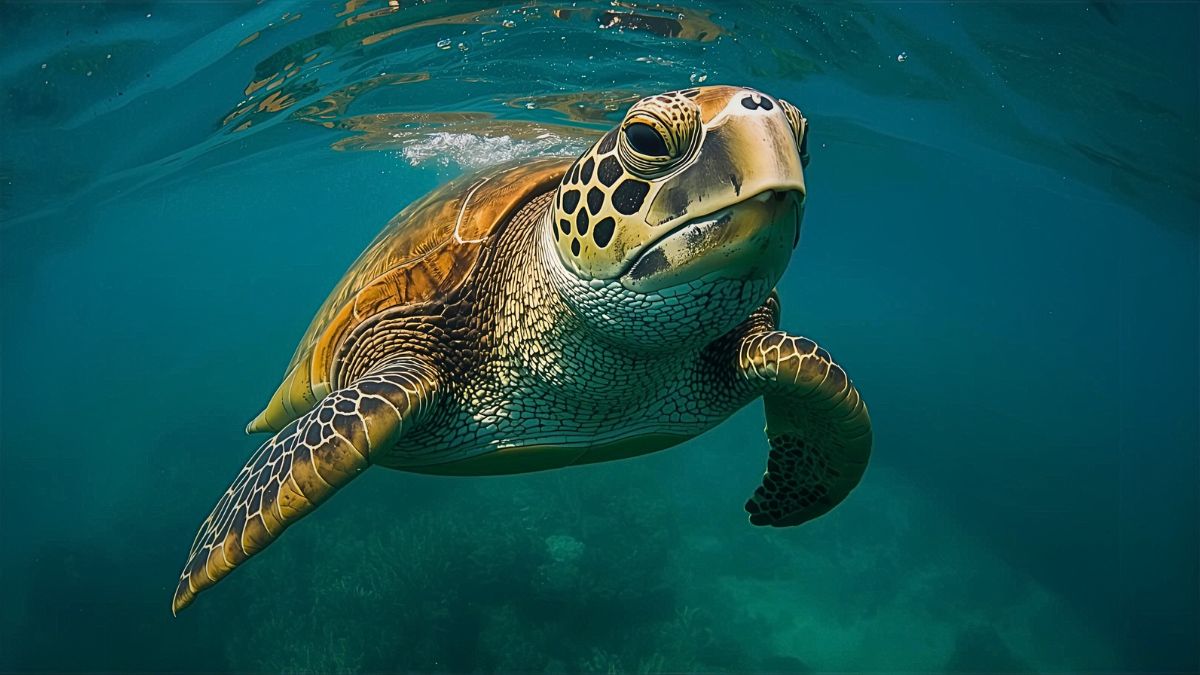
A poorly fitting mask creates a chain reaction of problems. Water leaks in. You clear it. It leaks again. You start breathing faster. Your air consumption goes up. Your dive gets shorter. And instead of watching that hawksbill turtle glide past the coral, you’re tilting your head back every 30 seconds trying to push water out of your nose.
There is nothing worse than a leaking mask.
I’ve seen students end dives early because of a leaking mask. I’ve seen experienced divers develop headaches from a mask that pressed too hard against the bridge of their nose. These aren’t equipment failures, they’re fit failures. And they’re completely avoidable if you know what to look for.
A mask that fits your face properly transforms your dive from a task into an experience. That’s not exaggeration – it’s something I see every single week.
What Should You Look for in a Diving Mask?
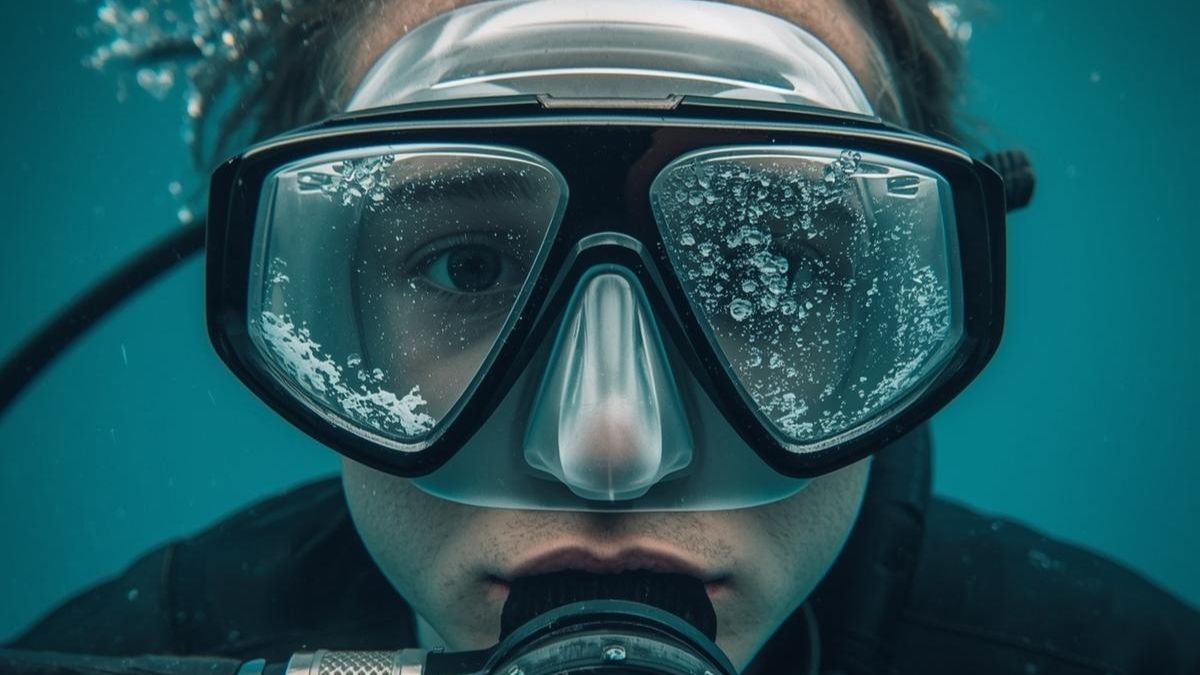
Before you start comparing brands or colors, you need to understand the four non-negotiable features every dive mask must have. Skip any of these, and you’re risking your comfort, or your safety.
- Tempered glass lenses are the first requirement. Regular glass or plastic can crack under pressure at depth. Tempered glass, that’s glass treated with heat to be stronger and shatter-resistant, won’t send shards toward your eyes if something goes wrong. Every legitimate dive mask has this. If the box doesn’t say “tempered glass,” walk away.
- A high-quality silicone skirt is what creates the seal between the mask and your face. Silicone is soft, flexible, and molds to your facial contours over time. Cheaper masks use PVC or low-grade rubber, which feels stiff, degrades faster in sun and saltwater, and simply doesn’t seal as well. You can feel the difference immediately when you press a quality silicone skirt against your skin – it’s smooth and pliable, not sticky or rigid.
- The nose pocket lets you pinch your nose to equalize pressure as you descend. Without it, you can’t equalize, and that means pain in your ears within a few meters. Make sure the nose pocket is roomy enough for your fingers to reach your nostrils easily, even when you’re wearing gloves.
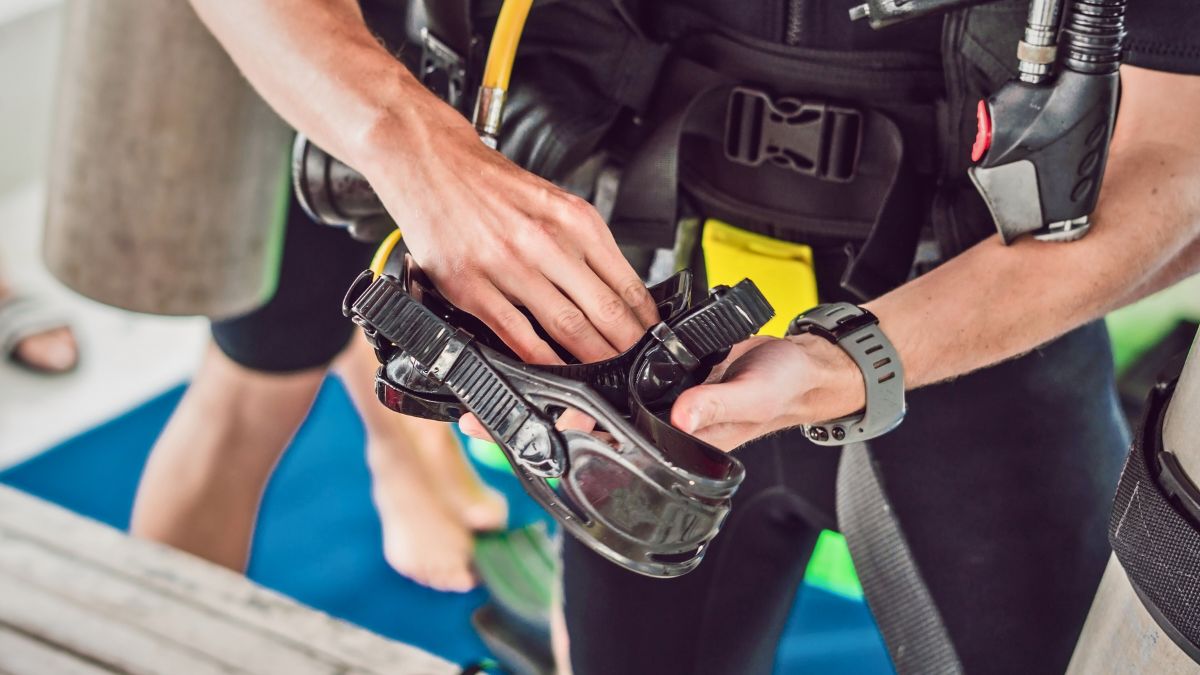
- Finally, a proper strap system holds the mask on your head, but here’s what most beginners don’t realize: the strap doesn’t seal the mask. Water pressure does that. The strap just keeps the mask in position. I’ll explain why this matters so much in a moment.
If your mask has tempered glass, quality silicone, a functional nose pocket, and an adjustable strap – you’ve covered the basics. Everything else is personal preference.
How Do You Test If a Dive Mask Fits?
This is the single most important step in choosing a diving mask, and it takes about 30 seconds. Here’s exactly how to do it.
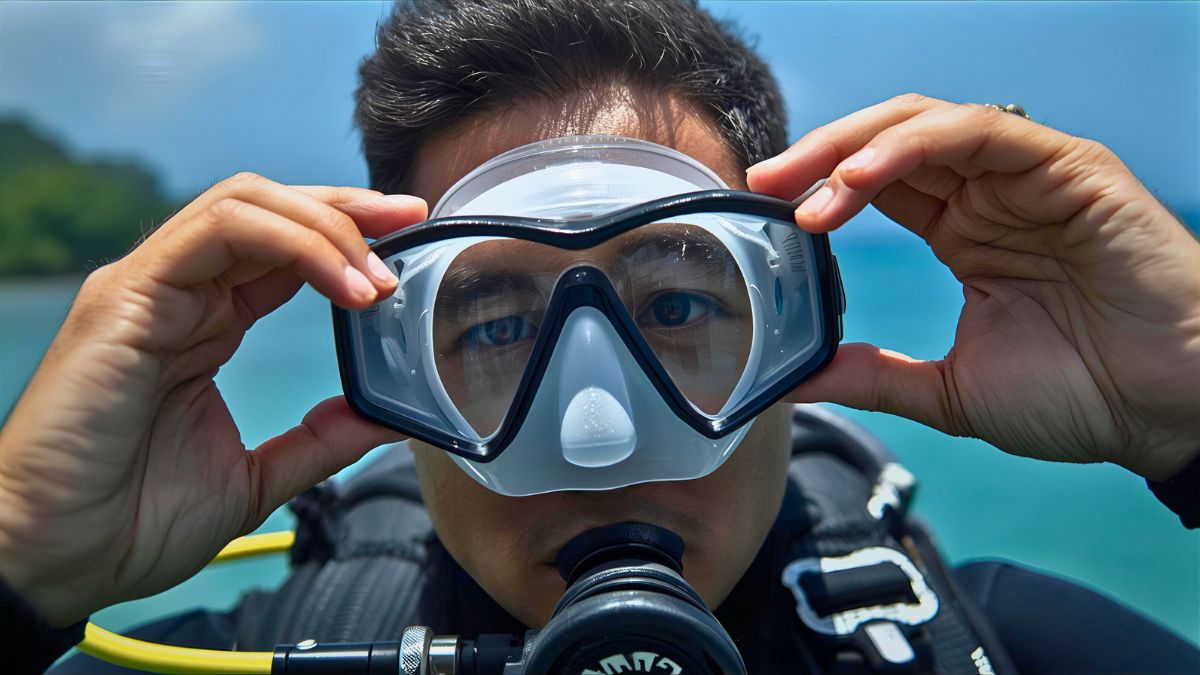
Hold the mask against your face without using the strap at all. Let the strap hang loose behind the mask. Now inhale gently through your nose. The mask should suction onto your face and stay there without any help from your hands. Look down. Look up. Tilt your head side to side. If the mask stays put, you have a good seal.
When you exhale through your nose, the mask should release and fall away naturally. If it doesn’t stick at all when you inhale, or if you can feel or hear air seeping in, that mask doesn’t fit your face. Don’t try to make it work. Try another one.
Don’t press the mask against your face!
One mistake I see constantly: people press the mask hard against their face during the test. This creates a false seal. You think the mask fits, buy it, and then discover underwater that it leaks. Let the suction do the work, not your hands.
Your face is not symmetrical. Nobody’s is. That means a mask that works perfectly for your dive buddy might leak on you. This is exactly why I tell my students to try at least three or four different masks before deciding. The right one will feel obvious, it’s the one you almost forget you’re wearing.
Did you know? The shape of the bridge of your nose is the most common reason a mask leaks. Even a tiny gap above the nose pocket lets water in on every single dive. That’s why trying before buying isn’t just advice – it’s the rule.
The fit test takes 30 seconds. A leaking mask ruins a 60-minute dive. Always test without the strap.
Single Lens vs Dual Lens vs Multi-Lens. Which Is Best?
This is where personal preference takes over from pure fit. Each lens configuration gives you a different underwater experience, and the best choice depends on what kind of diving you do.
| Feature | Single Lens | Dual Lens | Multi-Lens |
|---|---|---|---|
| Field of view | Wide, uninterrupted | Good, slight bridge obstruction | Widest (peripheral panels) |
| Mask volume | Higher | Lower | Moderate to high |
| Clearing ease | Requires more air | Quick and easy | Moderate |
| Prescription compatible | Limited | Yes — lenses can be swapped | Rarely |
| Best for | Recreational, photography | Beginners, glasses wearers | Divers who want maximum visibility |
- Single lens masks give you one continuous pane of glass across both eyes. The view feels immersive, almost like looking through a window rather than wearing a mask. I use a single lens frameless mask for most of my recreational dives because the field of view is excellent and the frameless design keeps it low-profile.
- Dual lens masks have two separate lenses divided by a nose bridge. They tend to sit closer to your face, which means lower volume, that’s less air to clear if water gets in. If you wear glasses, this is usually your best option because many manufacturers make prescription lenses that snap right in.
- Multi-lens masks add small side panels for extra peripheral vision. If you’ve ever felt that “tunnel vision” sensation in a mask, a multi-lens design can help. They let in more light from the sides, which some divers find reassuring.
Not sure which to try? Start with a dual lens mask. It’s the most versatile option for a beginner, it’s easy to clear, and it works with prescription lenses down the road if you need them.
There’s no objectively “best” lens type. The best one is whichever fits your face, matches your diving style, and gives you the view you enjoy most.
Does Mask Skirt Color Actually Matter?
More than you’d think. The skirt is the silicone part that seals against your face, and its color changes how your dive feels.
- Clear skirts let ambient light in from the sides. This creates a brighter, more open feeling inside the mask. For beginners, this is often the better choice because it reduces that enclosed sensation. If you’re diving in bright tropical waters, a clear skirt takes advantage of all that natural sunlight.
- Black skirts block peripheral light entirely. This gives you a more focused view through the lenses, almost like looking through binoculars. Underwater photographers prefer black skirts because they eliminate glare and reflections that can interfere with framing a shot. Many technical divers also choose black for the reduced visual distraction.
One practical note: black silicone hides dirt and discoloration much better than clear. After a year of regular diving, your clear skirt will start to yellow. A black skirt still looks new. That’s cosmetic, not functional but worth knowing.
For your first mask, go with a clear skirt. You’ll appreciate the extra light. If you move into photography or tech diving later, you’ll know exactly why you want black.
What Is Mask Volume and Why Should You Care?
Mask volume is the amount of air space between the lens and your face. It’s not something you can measure with a number on the box, you feel it when you put the mask on.
- Low-volume masks sit closer to your face. Less air inside means they’re faster to clear if water enters, and they require less pressure to equalize. They’re compact too – great for travel. I take a low-volume frameless mask on every dive trip because it folds flat and fits in a pocket of my dive bag.
- High-volume masks have more space between your face and the lenses. This creates a feeling of openness, you might describe it as “less claustrophobic.” The tradeoff is that they take a bit more effort to clear, and they can feel bulky.
If you’re just starting out, you probably won’t notice a huge difference either way. But if you tend to feel uncomfortable in tight spaces, lean toward a higher volume mask. If you want simplicity and easy clearing, a lower volume mask will serve you better.
Fun fact: During a typical recreational dive, most divers clear their mask two to four times. With a low-volume mask, each clear takes a short exhale through your nose. With a high-volume mask, you might need a fuller breath. Small difference, but over a 60-minute dive, you’ll notice it.
Low volume = easier clearing, better for travel. High volume = more open feel, good for claustrophobia. Neither is “better”, it depends on you.
How Do You Prevent a Dive Mask from Fogging?
Foggy masks are the number one complaint I hear from new divers. And nine times out of ten, it’s not the mask’s fault – it’s the preparation.
Every new mask comes from the factory with a thin silicone film on the inside of the lenses. This invisible residue is a leftover from manufacturing, and it causes fogging no matter how much defogging solution you use. Before your first dive, you need to remove it.
The simplest method: scrub the inside of each lens with white, non-gel toothpaste. Use your finger, rub firmly in small circles, rinse, and repeat three to four times. Some divers use a soft flame, briefly passing a lighter across the inside of the lens to burn off the film. But I only recommend this if you’re comfortable with the technique. Toothpaste works just as well and carries zero risk of damaging the lens.
Prepare your mask before diving
Before every dive, apply a commercial defog solution or a drop of baby shampoo to the inside of each lens. Rub it in, give it a quick rinse, and put the mask on. Once it’s on your face, don’t break the seal. Every time you lift the mask off your face and put it back on, you introduce warm air that will fog the lenses.
Diving in tropical conditions adds an extra challenge. The humidity here in Costa Rica means your mask fogs faster if you leave it sitting in the sun on the boat. Keep your mask in the shade, or better yet, dip it in the rinse bucket right before you giant stride in.
Prep your new mask once with toothpaste. Defog before every dive. Keep the seal once it’s on. Three steps – no more foggy dives.
Can You Dive with Glasses? Prescription Mask Options
Yes, and you have several options. Don’t let poor eyesight stop you from seeing the underwater world clearly.
- The most popular solution is a dual lens mask with prescription lenses. Many manufacturers – Cressi, TUSA, Aqualung, SCUBAPRO, offer drop-in corrective lenses that replace the standard lenses in specific two-lens mask models. You order your prescription strength, they snap in, and you’re ready to dive. It’s that simple.
- Optical lens inserts are another option. These are custom-made lenses that bond to the inside of your existing mask. They offer more precise correction, including for astigmatism, but they’re more expensive and require a recent prescription with your interpupillary distance, that’s the measurement between your pupils.
- Some divers wear contact lenses underwater. This works, but there are risks. Soft contacts are safer than hard contacts for diving. Always use daily disposables so you can toss them after the dive, reducing infection risk from waterborne bacteria. And be aware: if water floods your mask, you might lose a contact.
If you’re just getting started and aren’t sure you’ll dive regularly, contacts are the lowest-commitment option. If you’re investing in your own gear and plan to dive often, prescription lenses in a dedicated mask are worth every dollar.
What Are the Most Common Dive Mask Mistakes?
After years of teaching, I’ve seen the same mistakes repeat. Here are the ones that cost divers the most comfort, and how to avoid them.
- Over-tightening the strap. This is the most common mistake, and it’s the one I correct most often during PADI courses. The strap does not seal the mask. Water pressure does. When you crank the strap tight, you distort the silicone skirt, break the seal, and actually cause the leaking you’re trying to prevent. Plus, you end up with red pressure marks across your face. The strap should be loose enough that the mask doesn’t squeeze you, tight enough that it doesn’t fall off. That’s it.
- Buying online without trying the mask on. I understand the convenience. But every face is different – different nose width, cheekbone height, brow ridge shape. A mask that gets five-star reviews might leak on your particular face. Whenever possible, visit a dive shop and do the suction test in person.
- Choosing by color or brand instead of fit. Your mask might look amazing in turquoise and match your wetsuit perfectly. But if it doesn’t seal, none of that matters. Fit first. Color second. Always.
- Using a snorkel mask for scuba diving. Snorkel masks, especially full-face snorkel masks, are not designed for depth. They use plastic lenses that can crack under pressure, and they don’t allow you to equalize. This isn’t a shortcut – it’s a safety risk. Always use a mask specifically designed for scuba.
Did you know? A mask strap that’s too tight is actually the number one cause of mask leaking that I see in beginners. Not a bad mask, not the wrong size — just a strap pulled too tight. Loosening it by one or two clicks often fixes the problem instantly.
Every mistake on this list is fixable in under a minute. Know them before your first dive, and you’ll avoid hours of frustration.
How Much Should You Spend on a Dive Mask?
A solid, reliable dive mask from a reputable brand, costs between $40 and $120. That range covers the vast majority of recreational divers. You don’t need to spend $200 unless you’re looking at specialty features like prescription compatibility or ultra-low-volume technical designs.
What you’re paying for in that range is silicone quality, lens clarity, buckle durability, and engineering that keeps the mask comfortable over long dives. A $40 mask from a good brand will last you years if you care for it properly. A $15 mask from a beach shop will fog, leak, and degrade within months.
The one thing I would not recommend: buying the cheapest mask you can find and hoping it works. I’ve seen too many divers show up with flimsy masks that fell apart mid-trip. Your mask sits on your face for every second of every dive. It’s worth investing in quality – not luxury, but quality.
If you’re traveling to Costa Rica for diving and don’t own a mask yet, buying one at a dive center before your trip is a smart move. You can try it on, get advice from an instructor, and have time to prep it with toothpaste before your first dive.
Spend $50–$100 on a well-fitting mask from a recognized brand. That investment will serve you for hundreds of dives.
Frequently Asked Questions
How do I know if my dive mask is the right size?
The suction test tells you immediately. Place the mask on your face without the strap, inhale gently through your nose, and let go. If it stays on your face and no air seeps in, the size is right. If it falls or you hear hissing, try another model. Masks don’t come in standardized sizes like clothing – each model fits differently based on the skirt shape and nose pocket design, so you may need to try several before finding yours.
Why does my dive mask keep leaking?
The most common cause is an over-tightened strap. Loosening it one or two clicks often solves the problem. Other causes include hair caught under the skirt, a mask that simply doesn’t fit your face shape, or a worn-out silicone skirt that’s lost its flexibility. If you have facial hair, the area between your nose and upper lip is usually where water enters, a thin layer of silicone grease on the skirt can help seal that gap. If the leaking persists across multiple dives, the mask likely isn’t the right shape for your face. Read more about reasons for a leaking dive mask.
Is it better to buy or rent a dive mask?
Buy. A mask is the one piece of gear that needs to fit your unique face, and rental masks have been worn by hundreds of different faces. They’re often stretched, scratched, and foggy. If you’re only diving once and aren’t sure you’ll continue, renting is fine. But if there’s any chance you’ll dive again, owning your own mask, makes a real difference in comfort.
How do I take care of my dive mask?
Rinse it thoroughly with fresh water after every dive. Store it in a hard case or mask box, silicone skirts deform if you leave the mask lens-down or crammed into a bag. Keep it out of direct sunlight when you’re not using it, because UV degrades silicone over time. Avoid placing anything heavy on top of it. And here’s one many divers miss: insects are attracted to silicone and can actually damage it, so always store your mask in a sealed container.
Can I use a snorkel mask for scuba diving?
No. Snorkel masks are not built for depth. They typically use plastic lenses that can crack under pressure, and they don’t include a nose pocket for equalization. Using a snorkel mask for scuba diving is not just uncomfortable – it’s a genuine safety risk. Always use a mask designed and rated for scuba diving, with tempered glass and a proper nose enclosure.
What’s the best dive mask for beginners?
A dual lens mask with a clear silicone skirt and a comfortable nose pocket is the safest choice for most beginners. Dual lens masks are low-volume (easy to clear), compatible with prescription lenses if needed later, and widely available from all major brands. Don’t overthink it, fit matters more than any specific model. Visit a dive shop, try on several options, and pick the one that passes the suction test and feels comfortable on your face.
How often should I replace my dive mask?
A well-maintained mask from a quality brand lasts three to five years of regular use. Signs it’s time to replace: the silicone skirt feels stiff or tacky, the buckles crack or won’t hold adjustment, the lens has permanent scratches that affect your vision, or the mask no longer seals even after you’ve verified the strap tension. If you dive frequently in tropical conditions with strong sun, UV exposure may shorten the lifespan of the silicone. Check your skirt for yellowing or brittleness each season.
Can I dive with a mustache?
Yes. A mustache can make sealing a mask slightly trickier, but it’s absolutely manageable. Low-profile masks with soft, flexible silicone skirts work best because they conform more closely to the area above your lip. Applying a thin layer of silicone grease on the skirt where it contacts your mustache helps create a reliable seal. Some divers trim just the area directly under the nose. I’ve had plenty of students with full mustaches dive without any leaking issues, it just takes a little extra attention during mask selection.
Your Next Dive Starts with the Right Mask
Close your eyes for a moment and imagine this. You’re 12 meters down off Caño Island, and a whitetip reef shark glides past just a few meters ahead. The water is clear. Your mask sits comfortably on your face, no leaks, no fog, no pressure. You don’t even think about it. You just watch, breathe, and take in every detail of that moment.
That’s what a well-chosen mask gives you. Not just visibility, but the freedom to be fully present underwater.
Related Resources
Gear & Equipment:
- Reasons for a Leaking Dive Mask
- Diving Tank: Structure and Properties
- Technical Diving: How to Become a Technical Diver
Beginner Guides:
- Is Diving Safe? All About Safety in Diving
- How to Become a Certified Scuba Diver in Costa Rica
- Scuba Diving for Kids in Costa Rica
Destinations: