Every few dives, someone on the boat asks me about those tanks with the yellow-green bands. “What’s the difference?” they say. “Is it worth getting certified?” And then, without fail, they watch a nitrox diver stay down on a reef while the air divers have to ascend. By the next morning, they’ve already signed up for the course.
I’ve taught the Enriched Air Nitrox specialty more times than I can count. It’s the most popular scuba specialty in the world for a reason. But I’ve also watched divers use it without truly understanding it, which creates problems. So let me give you the honest version: what nitrox enriched air actually is, what it does for you, where it falls short, and whether the certification makes sense for your diving.
What Is Nitrox, Exactly?
Here’s something that surprises most people: the air you’re breathing right now is technically nitrox. Nitrox just means any mixture of nitrogen and oxygen. Normal air is roughly 21% oxygen and 79% nitrogen, which makes it Nitrox 21, or EAN21 if you want to be precise about it.
When divers talk about nitrox, they mean Enriched Air Nitrox (EANx), which is a gas mixture where the oxygen content is higher than 21%. The two most common blends in recreational diving are EAN32 (32% oxygen, 68% nitrogen) and EAN36 (36% oxygen, 64% nitrogen). These specific mixes were first developed by NOAA in the 1970s for scientific diving, and they became the standard for recreational use because they hit a good balance between extended bottom time and manageable depth limits.
You’ll also see the term “enriched air” used interchangeably with nitrox at most dive shops and resorts. They mean the same thing. The “x” in EANx originally came from “nitrox” but now indicates the oxygen percentage. So EAN32 means enriched air with 32% oxygen.
Why Does Less Nitrogen Matter?
To understand why enriched air nitrox is useful, you need to remember what you learned in your Open Water course: nitrogen is the limiting factor in recreational diving.
When you breathe compressed gas underwater, pressure pushes nitrogen into your bloodstream and tissues. The deeper you go and the longer you stay, the more nitrogen builds up. Your no-decompression limit (NDL) is essentially a countdown. Once it hits zero, you have to ascend or commit to decompression stops. Too much nitrogen too fast means decompression sickness, and nobody wants that.
Did you know? Nitrox was once called “voodoo gas” by skeptical recreational divers in the early 1990s when it was first introduced outside of scientific diving. Today it’s the most popular specialty certification offered by every major training agency.
Nitrox works by swapping some of that nitrogen for oxygen. Your body metabolizes oxygen, which does not accumulate the way nitrogen does. So with EAN32, you’re breathing 11% less nitrogen on every breath compared to air. That nitrogen builds up more slowly, your NDL extends, and you get more time at depth before you have to think about surfacing.
The secondary benefit is shorter surface intervals. After a dive, your body needs time to off-gas the dissolved nitrogen. Less nitrogen absorbed means less nitrogen to release, so you get back in the water sooner. On a multi-dive day, this adds up fast.
Real Numbers: How Much Extra Time Do You Actually Get?
I’ve found that divers don’t really feel the impact of nitrox until they see the numbers side by side. So here’s what the difference actually looks like at recreational depths:
| Depth | Air (NDL) | EAN32 (NDL) | EAN36 (NDL) |
|---|---|---|---|
| 15 m / 50 ft | 80 min | 125 min | 195 min |
| 18 m / 60 ft | 60 min | 92 min | 125 min |
| 24 m / 80 ft | 29 min | 42 min | 60 min |
| 30 m / 100 ft | 20 min | 27 min | 35 min |
These figures are based on NOAA no-decompression limits and are approximate. Your actual dive computer will calculate your specific NDL based on your dive profile. The pattern is consistent: at 18 meters, EAN32 gives you roughly 50% more bottom time than air. At 24 meters, EAN36 gives you twice as long as air.
On repetitive dives, the difference compounds. After a 45-minute dive to 18 meters on air, your second dive NDL at the same depth might be only 14 minutes. On EAN32, that same second dive can give you 43 minutes. That’s the difference between a rushed glimpse and a proper dive.
The Flip Side: Oxygen Toxicity and Depth Limits
Here’s where I have to be honest with you, because most articles skip this part or bury it at the end. Nitrox enriched air has real limitations, and if you ignore them, you create a serious safety problem.
The extra oxygen that extends your bottom time becomes dangerous at depth. Oxygen behaves differently under pressure. Specifically, its partial pressure (PPO2) increases as you go deeper. When PPO2 gets too high, oxygen becomes toxic to your central nervous system. Symptoms can include visual disturbances, ear ringing, nausea, and in severe cases, convulsions underwater. That’s not something you want to experience at 30 meters.
To stay safe, recreational nitrox diving limits PPO2 to a maximum of 1.4 ATA during the dive, with an absolute ceiling of 1.6 ATA. This creates a maximum operating depth (MOD) for each nitrox mix, a hard limit you cannot exceed.
Maximum Operating Depth at a Glance
| Nitrox Mix | O2 % | MOD (1.4 ATA) | MOD (1.6 ATA) |
|---|---|---|---|
| EAN32 | 32% | 34 m / 112 ft | 40 m / 132 ft |
| EAN36 | 36% | 28 m / 95 ft | 33 m / 108 ft |
| EAN40 | 40% | 24 m / 79 ft | 28 m / 92 ft |
Notice what this means practically: if you’re diving EAN36 and you go below 28 meters, you’re in the danger zone. Your MOD is not a suggestion. It is a hard limit. This is one reason I always tell students that nitrox is not a shortcut to diving deeper. It’s a tool for diving longer at moderate depths, not a pass to exceed recreational limits.
There’s also the concept of the CNS clock, which tracks your cumulative oxygen exposure across multiple dives in a day. Each dive uses up a percentage of your daily CNS oxygen tolerance. Your dive computer tracks this automatically if set up correctly for nitrox, but you need to understand what it’s measuring. Skipping this in your understanding is how people get into trouble on liveaboards doing five dives a day on enriched air.
Did you know? Oxygen toxicity was first documented in diving in 1878 by physiologist Paul Bert, who discovered that high oxygen pressures caused convulsions in animals. His research forms the basis of the PPO2 limits still used in dive training today.
Equipment: What You Actually Need
One of the most common myths I hear is that you need special equipment to dive nitrox. For recreational enriched air mixes up to 40% oxygen, that’s mostly not true.
Here’s what you actually need:
- A nitrox-compatible dive computer. Most modern scuba computers sold in the last decade already support nitrox. You just need to set the correct O2 percentage before each dive. If your computer was made after 2010, there’s a good chance it handles nitrox already. Check the manual.
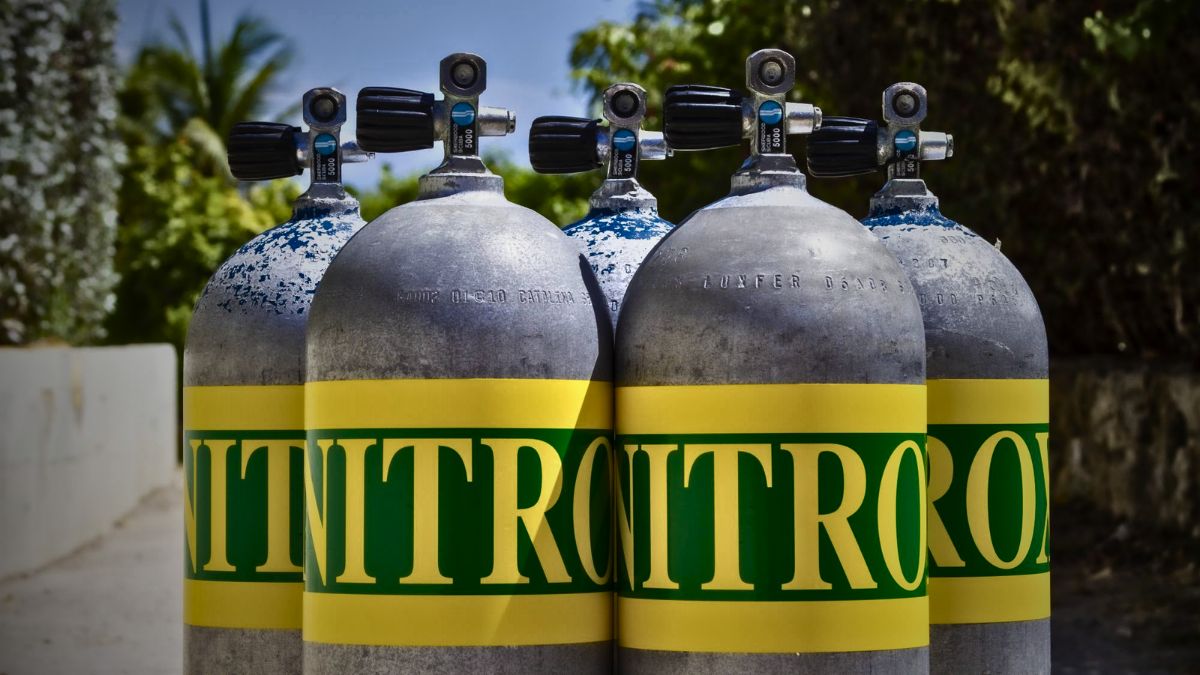
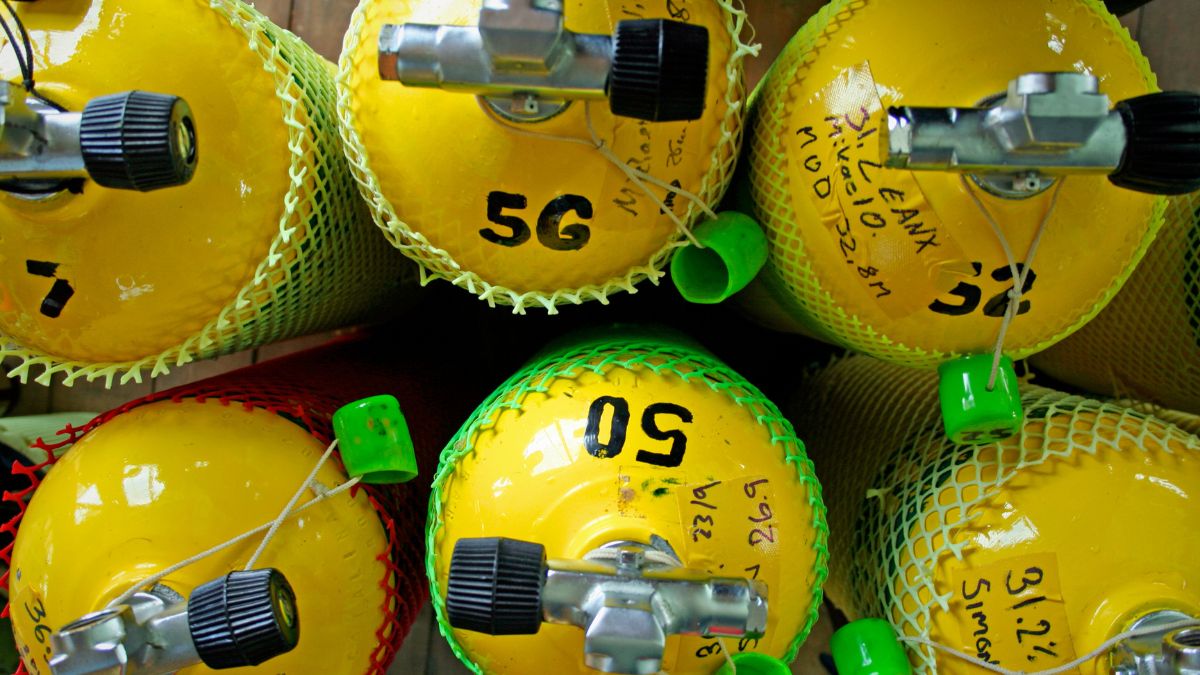
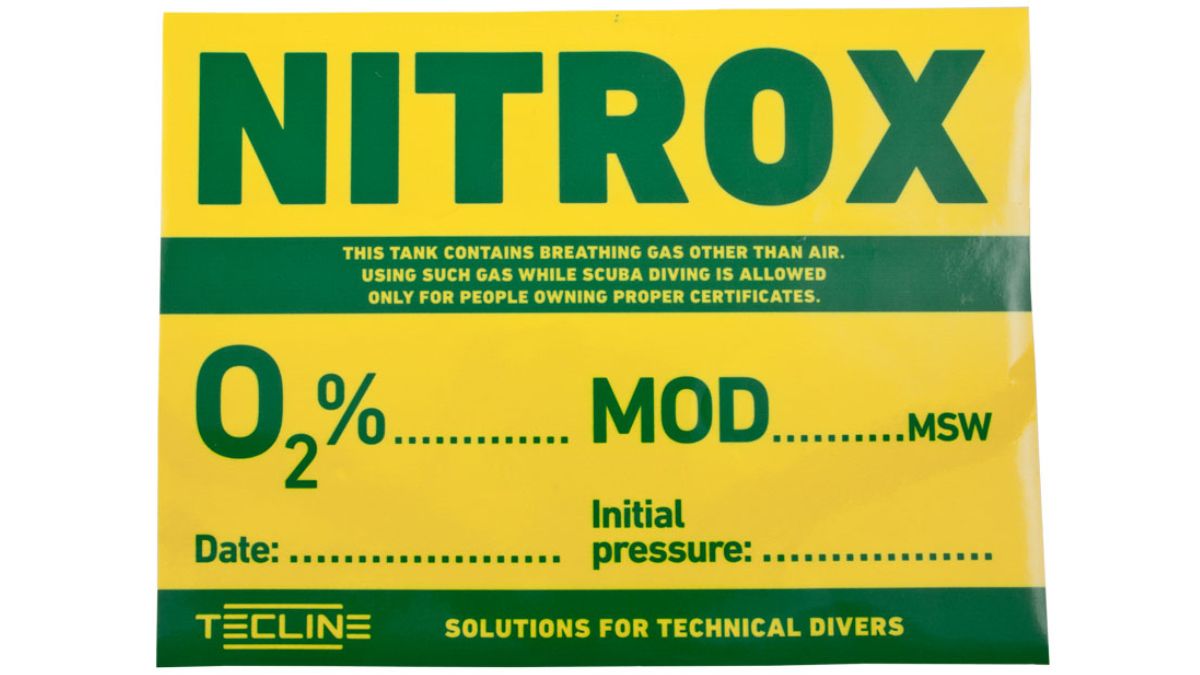
- A nitrox-clean tank. Tanks used for enriched air must be rated and cleaned for oxygen service. Your dive shop handles this, so you don’t need your own special tank, just make sure you’re getting a properly marked one (yellow-green bands with a nitrox sticker).
- An oxygen analyzer. You use this to verify the actual O2 percentage in the tank before every dive. The nitrox certification teaches you how to do this. It takes about 30 seconds and is non-negotiable. Never trust the label alone.
- Your scuba regulator works fine for mixes up to 40% O2. You don’t need an oxygen-clean regulator for recreational enriched air. That requirement only kicks in for mixes above 40%, which is the territory of technical diving.
Tank Labeling: Why It Matters More Than You Think
On a busy dive boat with twelve divers and twenty tanks, gas mix-ups happen. A diver grabs the wrong tank, dives air limits on a nitrox mix, and surfaces confused about why their computer is going crazy. Or worse: someone dives a nitrox tank thinking it’s air and exceeds their actual MOD without realizing it.
This is why every enriched air tank must carry specific information clearly visible before the dive:
- Fill date: when the mix was prepared
- Oxygen %: the actual analyzed O2 percentage
- Bar / PSI: the pressure in the cylinder
- Max. Depth (MOD): calculated from the O2 percentage
- Analyzed by: who verified the mix
- Diver name: the person responsible for this tank
That last point matters. Each diver is personally responsible for analyzing their own gas. This is one of the core skills in the enriched air course, and it’s one I take seriously with every student. Analyze the tank yourself, write the percentage on the label, set your computer to match. Don’t skip steps.
Is Nitrox Worth It for You? A Realistic Assessment
I’m going to be direct here because most articles just tell you nitrox is great and leave it at that. The honest answer is: it depends on how you dive.
Nitrox enriched air makes a real difference if you:
- Do multi-dive days (2–4 dives per day), where shorter surface intervals and longer second dives are where nitrox shines
- Dive regularly in the 15–30 meter range, the sweet spot where NDL extensions are most significant
- Go on liveaboards, where 5 dives a day on nitrox vs. air is a completely different experience
- Do underwater photography, where you need time to wait for the right moment, not watch your NDL count down
- Want extra safety margin: diving nitrox on air profiles means you accumulate far less nitrogen than your limits allow
Nitrox makes less difference if you:
- Do single shore dives with long surface breaks between days
- Consistently dive shallower than 12 meters, since NDL is not your limiting factor there, your air supply is
- Regularly dive deeper than 30 meters, since at that depth, nitrox depth limits become restrictive and you’d need trimix instead
There’s one more practical reason to get certified that most guides don’t mention: many dive resorts now offer free nitrox as a standard perk for certified divers. If you show up without certification, you can’t use it even if it’s included in your package. I’ve seen divers miss out on free enriched air fills every day of a week-long trip simply because they didn’t spend one afternoon getting certified before they left home.
The Enriched Air Nitrox Course: What to Expect
The PADI Enriched Air Diver course is the most popular specialty certification in recreational diving. SSI offers an equivalent program called the SSI Enriched Air Nitrox specialty. Both cover the same core material and are recognized worldwide.
The course requires you to be at least 12 years old and hold an Open Water Diver certification (or equivalent). There are no mandatory open-water dives. The certification focuses on knowledge and practical skills rather than underwater time. This makes it unusual among diving courses: you can complete it in a single day, or even split the eLearning at home and finish the practical session at a dive shop.

In the practical session, you’ll learn to use an oxygen analyzer to verify your gas mix, set your dive computer for nitrox, complete an enriched air log, and review the dive planning considerations that differ from air diving. It’s genuinely straightforward. I’ve had students complete the full course in three hours.
Two optional open-water dives are sometimes offered if you want to practice in the water with nitrox before diving independently. I recommend taking them if your schedule allows. There’s real value in doing your first nitrox dive with an instructor present, even if it’s not required.
Frequently Asked Questions
Can I breathe nitrox without certification?
Technically you can breathe any gas, but legally and ethically, no. Dive shops require a valid nitrox certification to fill enriched air tanks. Diving nitrox without training means you don’t know how to calculate your MOD, set your dive computer correctly, or interpret your CNS clock. That’s how accidents happen.
Does nitrox help with nitrogen narcosis?
No, and this is a persistent myth worth clearing up. Nitrogen narcosis occurs due to the narcotic effect of gas under pressure, and oxygen has a similar narcotic effect to nitrogen. Switching to nitrox does not reduce narcosis. If you’re feeling narced at 30 meters on nitrox, the solution is to ascend, not to breathe more oxygen.
Do I need a special regulator for nitrox?
For recreational enriched air mixes up to 40% oxygen, your standard regulator works fine. Oxygen-clean regulators are only required for mixes above 40%, which falls into technical diving territory and involves a different certification path entirely.
How do I know what percentage of nitrox is in my tank?
You analyze it yourself with an oxygen analyzer before every dive. This is non-negotiable and one of the core skills you learn in the enriched air course. Stick the analyzer probe into the tank valve, open the valve briefly, and read the O2 percentage. Write it on your tank label and set your dive computer to match.
Is nitrox more expensive than regular air?
At most dive shops and liveaboards, yes, typically a few dollars more per fill. However, as mentioned, many dive resorts now offer nitrox at no extra charge for certified divers. Over a week of diving, the cost difference is usually minor compared to the benefit of extended bottom times.
What happens if I accidentally dive below my MOD on nitrox?
Your PPO2 exceeds safe limits, increasing the risk of central nervous system oxygen toxicity. Symptoms can come on very quickly and without warning. Convulsions underwater are potentially fatal. This is why knowing your MOD before the dive and diving with a computer that shows current depth vs. MOD is so important. If you see your depth approaching MOD, ascend immediately.
Sources and References
- PADI Enriched Air Diver Course: course requirements and curriculum overview
- SSI Enriched Air Nitrox Program: SSI enriched air specialty training details
- DAN: Air, Nitrox and Fatigue: Divers Alert Network research on post-dive fatigue and enriched air
- NOAA Ocean Service: Nitrox: NOAA background on enriched air and its origins in scientific diving
- Wikipedia: Nitrox: history of EAN32/EAN36 development and NOAA nitrox standards