
The first time I got properly lost on a dive, I was in maybe 8 meters of water on a reef I had dived dozens of times before. Visibility was fine. Conditions were calm. I simply turned around once too many times looking at a turtle, lost track of which direction I came from, and spent the next ten minutes swimming in completely the wrong direction before I figured it out.
Getting lost underwater is much easier than most divers expect. There is no GPS. There are no road signs. The current quietly pushes you off course while you are busy watching something interesting. And when you look up, everything looks the same in every direction.
Underwater navigation in scuba diving is the set of skills that stops this from happening. It lets you find your way to a specific spot, return to the boat or the shore, and explore a dive site with purpose instead of wandering. It is not about being perfect. It is about knowing what to pay attention to and what to do when things go sideways.
Why Underwater Navigation Is Harder Than You Expect
On land, navigation is mostly automatic. You use road signs, buildings, the sun, your phone. You are oriented without thinking about it. Underwater, all of those references disappear at once.
The sun is still useful, but only if the water is clear and you remember to check it before you descend. There are no roads. Coral heads and rock formations look different from different angles, and after 20 minutes at depth, you may not recognize a landmark you swam past earlier. To make things worse, currents push you sideways without you feeling it, so you can swim on what feels like a straight line and end up 30 meters off course by the time you turn around.
Add to this the fact that you are simultaneously managing your buoyancy, watching your air, keeping your buddy in sight, and looking at the marine life around you. Navigation is just one more thing your brain has to track. That is why it takes practice, not just knowledge.
The Two Main Approaches to Underwater Navigation
Natural Navigation
Natural navigation means using the features of the environment around you to stay oriented. It is the older of the two approaches and still the most useful on a day-to-day basis, because it does not require any equipment.
The starting point is the bottom profile. Every dive site has a shape. There might be a wall that drops off to the left, a sandy channel running north-south, a coral ridge at 12 meters, or a series of boulders that lead from the mooring line toward the deeper reef. Before you descend, look at the site from the surface and try to build a rough mental map. Which direction is the current running? Where is the sun? Is the bottom sloping, flat, or dropping away?
Once you are underwater, use fixed features as reference points. A large coral head, a distinctive rock formation, an anchor line, a change in bottom type from sand to rubble. These are your landmarks. What you cannot rely on are moving features: a school of fish in a particular spot, a patch of kelp that bends in the current, or the position of other divers.
Keep your eyes open
The sun is genuinely useful when visibility is good. Before entering, note which side the sun is on relative to the dive site. Underwater, the light rays angle from a predictable direction, and you can use them to check your orientation without surfacing. This does not work in murky water or on an overcast day, but in good tropical conditions, it is a reliable backup.
Currents are also information. If you know the current is running from west to east, and you dive into the current on the way out, you can ride it back on the return leg with less effort. Many experienced divers plan their dives around the current direction precisely because of this.
Compass Navigation
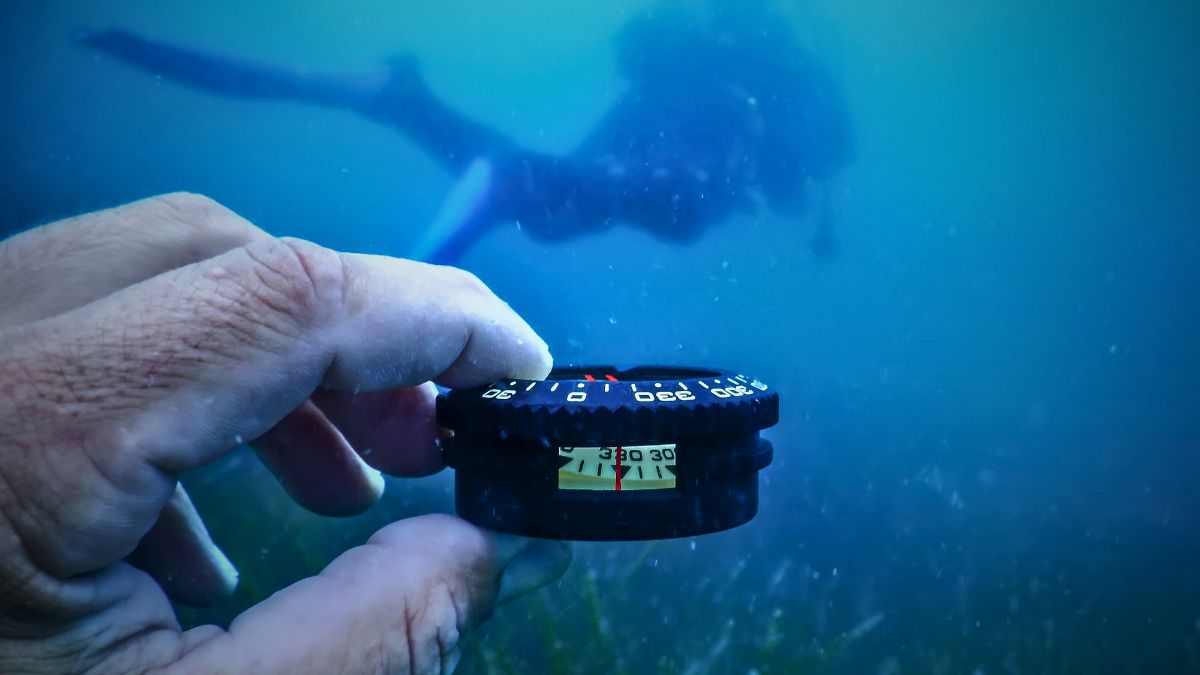
A compass tells you which direction you are heading when natural cues are not enough. In low visibility, inside a wreck, on a featureless sandy bottom, or anywhere you cannot rely on landmarks, a compass becomes your primary navigation tool.
Most recreational divers have a compass but fewer know how to use it well. The good news is that the basic technique is not complicated. It just requires understanding a few things about how a diving compass works.
How to Read and Use a Diving Compass
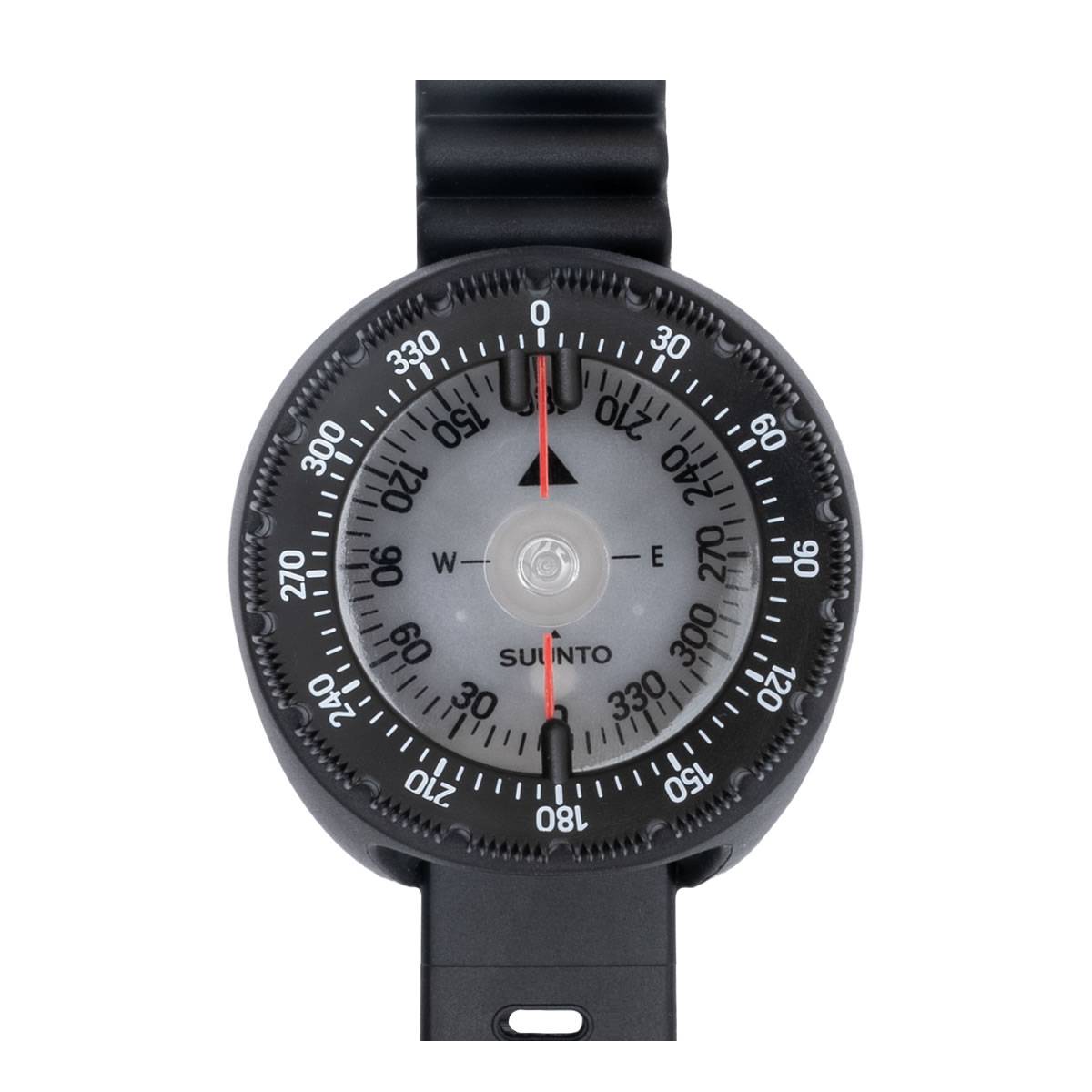
A diving compass has three parts you need to understand. The lubber line is a fixed line on the compass body. It always points in the direction you are traveling. When you swim, the lubber line represents your heading. The compass needle (or floating card) always points north, regardless of which way you are facing. The bezel ring is the rotating outer ring marked in degrees from 0 to 360. You rotate it to mark and hold a specific heading.
The most important thing about holding a compass underwater: keep it perfectly level. If you tilt it even slightly, the needle drags against the housing and gives you a false reading. Hold it in front of your chest, centered on your body. Some divers mount the compass on their wrist, which works but makes it harder to keep it level while swimming.
Keep your compass at least 30 centimeters away from your dive computer, tank valve, or any other metal or electronic equipment. Steel tanks and dive computers can pull the needle off north and give you a false bearing without you knowing it.
Did you know? GPS signals cannot penetrate water. Radio waves used by GPS satellites are absorbed within a meter or two of the surface, which is why there is no underwater GPS system available to recreational divers. This makes compass and natural navigation the only reliable tools for orientation at depth.
Setting and Swimming a Heading
Before you enter the water, decide on your heading. Point your body in the direction you want to swim. Look at the compass and note the degree reading on the lubber line. Rotate the bezel ring so its index mark aligns with the compass needle. Now that heading is locked in. As long as the needle stays aligned with the bezel index marks while you swim, you are on course.
Here is a tip I give every student: do not stare at the compass the whole time. Look up, pick a fixed object in your path (a coral head, a rock, a distinctive feature of the bottom), swim to it, then check the compass again and pick the next point. This way you stay aware of your surroundings instead of swimming blindly with your eyes on the instrument. I have watched students swim straight past the mooring line because they were staring at their compass instead of looking where they were going.
To return to your starting point, you need the reciprocal heading. This is simply your outbound heading plus or minus 180 degrees. If you swam out on a heading of 60 degrees, your return heading is 240 degrees. If your outbound heading was 280 degrees, the return is 100 degrees. Most diving compasses have reciprocal markings on the bezel to make this easier to read. Set it before you descend so you do not have to do mental arithmetic at depth.
Dealing with Current When Using a Compass
A current running across your path is one of the trickiest navigation problems. You can swim on a perfect compass heading and still end up well off course because the water is pushing you sideways the whole time.
The solution is to angle your swimming direction into the current to compensate. If the current is coming from your left, angle your body slightly to the left while keeping the compass reading correct. You will feel like you are swimming at an angle, but your actual path through the water will be straighter than if you tried to swim directly on the heading.
This is an approximation, not an exact science. With practice you develop a feel for how much correction a given current requires. On very strong currents, even experienced divers struggle to hold a precise line.
Measuring Distance: The Kick Cycle Method
Knowing which direction you are going is only half the problem. You also need to know how far you have traveled, so you know when to turn around.
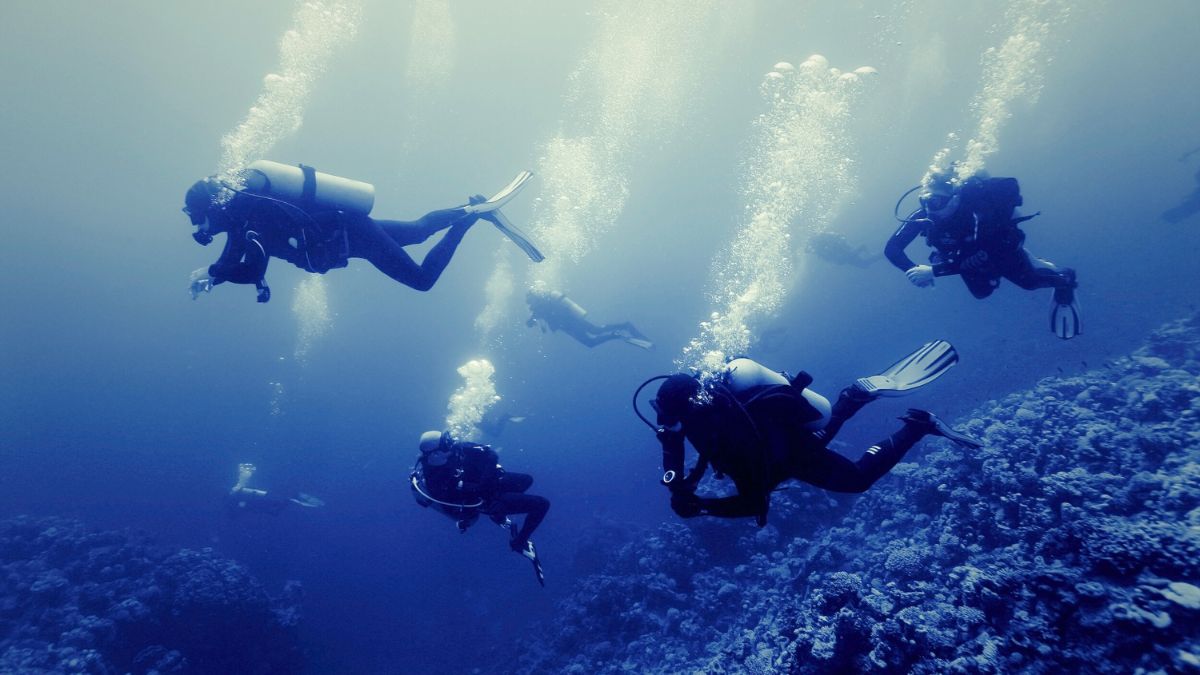
The most practical method for recreational diving is counting kick cycles. A kick cycle is one complete up-and-down movement of both fins together. Not one kick of one leg, but one full cycle of both. Most divers cover roughly 1.5 to 2 meters per kick cycle at a relaxed swimming pace, but this varies significantly by diver, fin type, and how hard you are kicking.
Before you rely on this method for navigation, calibrate it for yourself. On a flat, calm dive with no current, count how many kick cycles it takes to cover a known distance, such as the length of the boat. Do this a few times and you will get a consistent number. Now you have a baseline you can actually use.
Watch out for the current
The important caveat: kick counting only works reliably in still water or when you account for current. If you swim 100 kick cycles with a 1-knot current behind you, and then swim 100 kick cycles back against the same current, you will not end up where you started. You will be short of your starting point. This is why natural navigation and compass navigation are always used together, with kick counting as a supporting tool rather than the primary one.
Time is a rougher alternative. Note the time when you start swimming a heading, and estimate the return based on how long the outbound leg took. This works less well because your speed changes with effort, depth, and current, but it is better than nothing if you lose count.
What to Do When You Get Lost
It happens to everyone. You look up, and nothing looks familiar. The mooring line is not where you expected it. Your buddy is where you thought the boat was. Here is what to do.
Stop. Do not swim in random directions hoping to stumble onto something recognizable. Every meter you swim in the wrong direction is a meter you have to come back from.
Look around first. Sometimes the mooring line is 10 meters away and you just did not see it because you were looking at the bottom. Check the full 360 degrees at your current depth before doing anything else.
Don’t panic
If that does not work, do a boat check. Ascend slowly to a safe shallow depth, no deeper than 5 meters, while watching for boat traffic above you. Once you can see the surface, take a bearing on the dive boat, the shore, or the mooring buoy. Descend back down with the compass heading locked in and swim toward it. This is one of the most practical and underused navigation techniques in recreational diving, and it is exactly why compass skill matters even on easy dives.
What you should not do is make a panicked ascent, bolt for the surface, or use up your air swimming in random directions. Stay calm, stop moving, and think through what you know about the site before you act.
Fun fact: Underwater orienteering is an actual competitive sport. Divers use compasses and distance-counting techniques to navigate a marked course as accurately and quickly as possible. It has been practiced in Scandinavia since the 1970s and has a small but dedicated international following.
Natural Navigation in Practice: What I Actually Look For
Here is how I personally approach natural navigation on a dive, in case it helps to see the thought process laid out.
Before I enter the water, I check the sun position and note which side it is on relative to the dive site. I look at which direction the surface current is moving and estimate whether it will be the same at depth. If I have dived the site before, I try to remember two or three fixed landmarks I can use to orient myself: a big anchor chain, a distinctive coral structure, a sand channel.
During the dive, I check my position against these landmarks every few minutes rather than waiting until I am already confused. Staying oriented continuously is much easier than trying to reconstruct your position after you have wandered.
On sites I have never dived before, I stay closer to the guide than I would on a familiar site, and I spend the first few minutes building a mental map before I start exploring. Which way is the drop-off? Where is the mooring line relative to the reef? Is the sandy bottom on my left or my right?
The mooring line itself is one of the most useful navigation tools on any boat dive. It is a fixed reference that tells you exactly where the boat is. On dives with poor visibility, I always note the compass heading from the mooring line to wherever I plan to go, so I can reverse it on the way back.
When to Take the Underwater Navigator Course
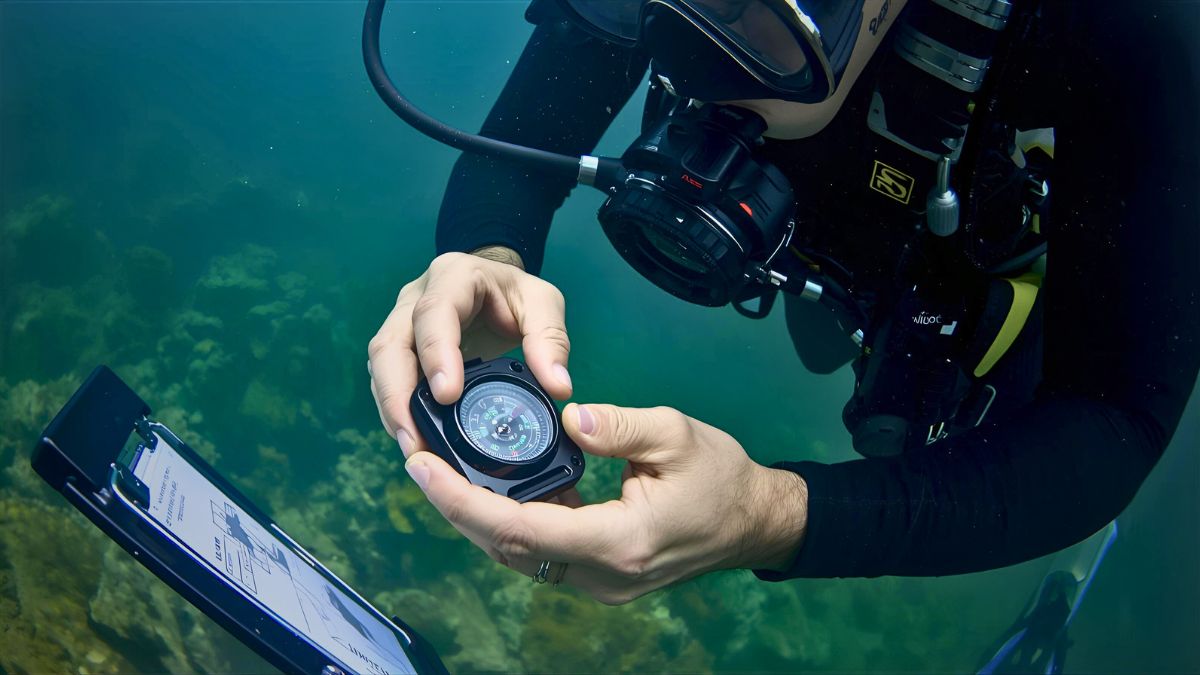
Navigation is covered briefly in the Open Water course and more thoroughly in the Advanced Open Water course, where it is one of the two mandatory adventure dives. The PADI Underwater Navigator specialty takes it further still, with two focused dives specifically on compass techniques, natural navigation, search patterns, and distance estimation.
I recommend this course for anyone who regularly dives without a guide, anyone planning to dive wrecks or sites with low visibility, and anyone who has felt anxious or uncertain about finding their way back on a dive. Two dedicated dives with an instructor focused entirely on your navigation technique will teach you more than ten recreational dives where navigation is just one of many things happening at once.
Even if you do not take the specialty, practice is what builds the skill. On every dive, even easy guided dives, pay attention to where you are. Note the heading from the mooring line. Count kick cycles for a section of the dive. Practice reading the compass while hovering still. These small habits build up, and after 30 or 40 dives of paying attention, underwater navigation stops feeling like a chore and starts feeling like second nature.
Frequently Asked Questions
What is underwater navigation in scuba diving?
Underwater navigation is the set of techniques divers use to find their way around a dive site, reach specific points of interest, and return safely to the boat or shore. It combines compass navigation, natural navigation using environmental cues, distance estimation, and dive planning done at the surface before entry.
How do I use a compass for scuba diving?
Hold the compass level in front of your chest, away from any metal or electronics. Point yourself in your intended direction, note the heading on the lubber line, and rotate the bezel ring to align with the compass needle. As you swim, keep the needle aligned with the bezel index marks to stay on course. For the return trip, add or subtract 180 degrees from your outbound heading to get your reciprocal.
What is a reciprocal heading in diving?
A reciprocal heading is the compass bearing that points you back to where you started. It is your outbound heading plus 180 degrees (if the result is over 360, subtract 360). For example, if you swam out on 045 degrees, your reciprocal is 225 degrees. Most diving compasses show reciprocal markings directly on the bezel to save you the calculation at depth.
What is the kick cycle method for measuring distance underwater?
A kick cycle is one complete up-and-down movement of both fins. By counting kick cycles, you can estimate how far you have traveled. Calibrate your own kick cycle distance on a calm dive over a known distance before relying on it for navigation. Be aware that current will affect how far each kick cycle takes you, so this method is most reliable in still water.
What should I do if I get lost underwater?
Stop swimming immediately and look around at your current depth. You may be closer to a reference point than you think. If you cannot orient yourself from where you are, ascend slowly to a shallow depth, watch for boat traffic, and take a compass bearing on the dive boat or buoy. Descend with the heading locked in and swim toward it. Stay calm. Panicking burns air and makes good decisions harder.
Do I need the PADI Underwater Navigator course?
You do not need it, but it is worth taking if you dive without guides regularly, plan to explore wrecks, or dive in conditions with reduced visibility. The course gives you two focused practice dives with an instructor specifically watching and correcting your compass and natural navigation technique. Most divers improve noticeably after just those two dives.
Sources and References
- PADI Underwater Navigator Course – Official course outline and training standards
- DAN Alert Diver – Advanced Underwater Navigation – In-depth guidance on navigation techniques
- Wikipedia – Diver Navigation – Reference overview of navigation methods, equipment, and training