I still remember my first giant stride entry. Standing on the edge of a dive boat in the Gulf of Papagayo, heart pounding, fins dangling over the water. My instructor gave me a nod, and I stepped into the blue. That moment changed everything.
After years of teaching scuba diving in Costa Rica, I have watched hundreds of students take their first leap. Some nail it on the first try. Others splash awkwardly, lose a fin, or surface with a flooded mask. The difference almost always comes down to technique.
Knowing how to dive into the water properly is not just about looking cool. It protects your equipment, keeps you safe, and sets the tone for your entire dive. In this guide, I will walk you through five essential water entry techniques that every diver should know.
Why Does Your Water Entry Technique Matter?
You might think getting into the water is the easy part. Gravity does most of the work, right?
Not exactly.
A poor water entry can knock your mask off your face. It can send your fins sinking to the bottom. In strong currents, a hesitant entry might separate you from your dive group before you even start. I have seen all of these happen on the same dive trip.
How to Dive Into the Water?
Good entry technique protects your gear. Masks, regulators, and cameras can come loose on impact with the water. Holding everything in place prevents expensive losses and frustrating dive interruptions.
More importantly, proper technique keeps you safe. Entering the water correctly means you surface in control, oriented, and ready to signal your boat or buddy. You avoid hitting other divers below. You prevent back strain from awkward landings.
Think of your water entry as the first skill of every dive. Get it right, and you start with confidence. Get it wrong, and you spend the first few minutes recovering instead of exploring.
What Is the Giant Stride Entry and When Should You Use It?
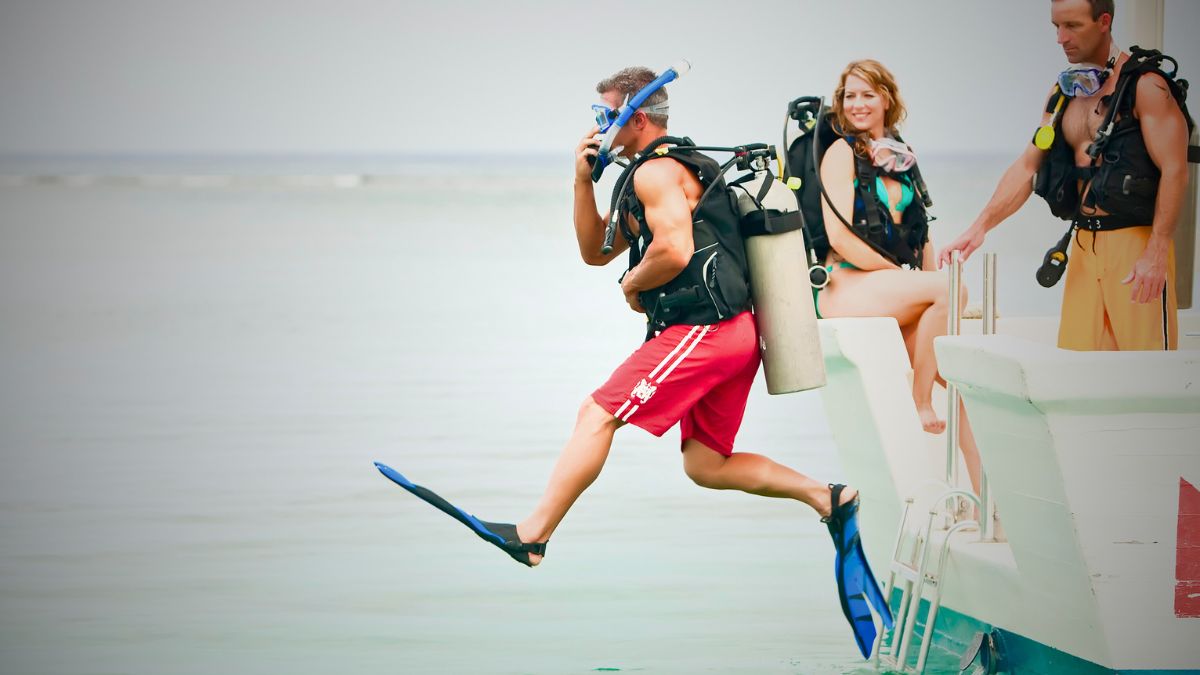
The giant stride is the most common water entry technique in scuba diving. You will learn it in your Open Water course, and you will use it on countless dives afterward.
This method works best when entering deep water from a stable platform. Large dive boats, liveaboards, piers, and jetties are ideal. The platform should be high enough that you step down into the water rather than slide in.
How Do You Perform a Giant Stride Correctly?
Here is the step-by-step process I teach my students.
Put on all your gear and complete your buddy check. Make sure your BCD is partially inflated, about halfway full. This ensures you will float back to the surface after entry.
Walk to the edge of the platform. Position yourself so the tips of your fins hang slightly over the edge. Keep your regulator in your mouth and breathe normally.
Before jumping into the water, check what’s below.
Before you jump, look down. Check that the water below is clear of other divers, obstacles, and marine life. Look to both sides as well. This three-point check takes two seconds and prevents collisions.
Now secure your equipment. Place the palm of one hand over your regulator, with your fingers pressing the top of your mask frame against your face. This single hand position protects both pieces of gear. With your other hand, hold your weight belt buckle or press against the back of your head to secure your mask strap.
Giant Stride water entry
Stand tall and look toward the horizon. This posture helps you step far enough forward to clear the platform with your tank.
When ready, take one large step forward with your leading leg. Keep your other leg back for balance. Do not jump upward. Simply step out and let gravity take you down.
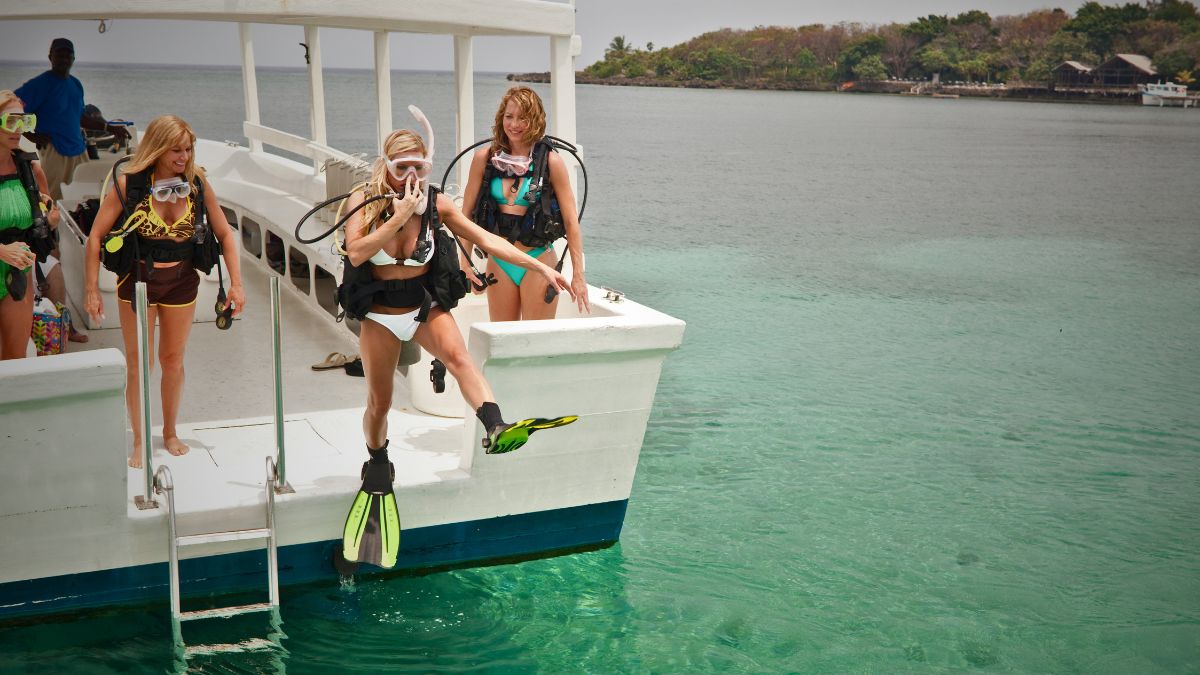
As you enter the water, bring your legs together. The air in your BCD will bring you back to the surface within seconds. Turn toward the boat and give the OK signal by placing your fist on top of your head or making a circle with your thumb and finger.
What Are Common Giant Stride Mistakes to Avoid?
The most frequent mistake I see is looking down during the step. When you drop your chin, your body tilts forward. This can cause a face-first entry that floods your mask and disorients you.
Another common error is stepping too timidly. A small step might not clear the platform. Your tank can hit the edge of the boat on the way down. Commit to a full stride.
Some divers forget to inflate their BCD before entry. Without enough air, you sink immediately after hitting the water. Beginners should always have positive buoyancy for their first surface moment.
Many students release their mask too early. Keep your hand in place until you have fully surfaced and oriented yourself. Only then should you let go to give your signal.
Did you know? The giant stride entry gets its name from the exaggerated stepping motion. Early diving manuals called it the “step-off entry,” but the more dramatic name caught on because it better describes the confidence the technique requires.
How Do You Do a Back Roll Entry From a Small Boat?
If you have ever watched divers tumble backward off a rubber inflatable boat, you have seen the back roll entry. This technique is essential for small craft diving and very common here in Costa Rica, where pangas and inflatable boats are popular.
Small boats sit low in the water and lack stable platforms. Standing up in full scuba gear on a small boat is dangerous. You can tip the boat or lose your balance as it rocks. The back roll solves both problems.
Step-by-Step Back Roll Technique
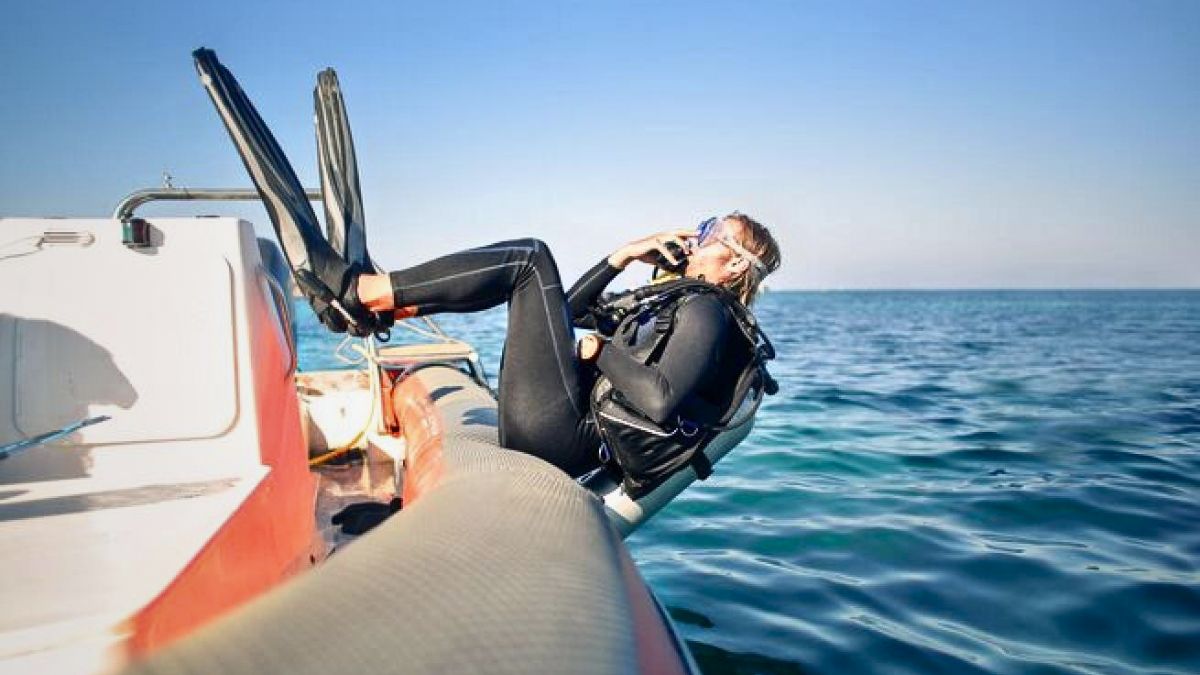
Start by sitting on the edge of the boat with your back toward the water. Your tank should hang over the side. Your fins should point inward toward the boat’s center.
Scoot back until you are balanced on the edge. Cross your ankles to keep your legs together during the roll. Put your regulator in your mouth and breathe normally.
Remember to secure the mask
With one hand, secure your mask and regulator using the same palm-and-fingers position from the giant stride. With your other hand, reach behind your head and cup the back of your skull. This protects your head from hitting the first-stage regulator during the backward motion.
Tuck your chin toward your chest. Keeping your chin down prevents whiplash and helps you roll smoothly.
Wait for the boat handler or divemaster to give the go signal. When you hear it, lean backward and roll off the edge. Do not push hard. A gentle lean is enough.
You will do a small somersault underwater. The air in your BCD brings you right back up. Surface, orient yourself toward the boat, and give the OK signal.
Why Do Scuba Divers Fall Backwards Into the Water?
This is one of the most common questions I hear from non-divers. The answer comes down to physics and practicality.
On a small boat, standing up with a heavy tank creates a high center of gravity. This makes the boat unstable and puts you at risk of falling in an uncontrolled way. Sitting low keeps the boat balanced.
Rolling backward is also gentler on your body. The curved motion distributes the impact across your shoulders and tank rather than sending a jolt through your spine. Your equipment stays more secure because the rotation is smooth rather than sudden.
And yes, the old joke is true. Divers fall backward because if they fell forward, they would fall into the boat.
When Should You Use the Seated Entry Method?
The seated entry is less dramatic than the giant stride or back roll, but it has important uses. I recommend this method in three situations.
- Use it when the water is too shallow for a giant stride. Jumping into shallow water can cause injury or damage coral below. The seated entry lets you slide in gently.
- Use it when your platform sits very close to the water surface. Docks just above the waterline and some boat transoms work well for seated entries.
- Use it when the platform is unstable. If you cannot stand confidently with gear on, sitting down and sliding in is the safer choice.
How to Execute a Safe Seated Entry
Sit on the edge of the platform with your fins dangling in the water. Put your regulator in your mouth and secure your mask with one hand.
Place both hands on the platform beside your hips. Lift your body slightly using your arms, then push yourself outward and forward. The goal is to clear the edge so your tank does not scrape against it.
Lower yourself into the water smoothly. You can rotate your body during the descent if needed to enter at a comfortable angle.
This method also works well for divers with mobility challenges or those recovering from injuries. It requires less athletic movement than other entries and keeps you in control throughout.
What Is the Best Way to Enter the Water From Shore?
Shore diving is popular worldwide. Here in Costa Rica, several dive sites are accessible from beaches. Entering the water from shore requires a different approach than boat entries.
The surf zone, rocks, and waves create challenges you do not face on a stable dive platform. Your entry method must account for these variables.
Wading Entry for Calm Conditions
When conditions are calm and the entry zone is sandy with minimal waves, the wading entry works perfectly.
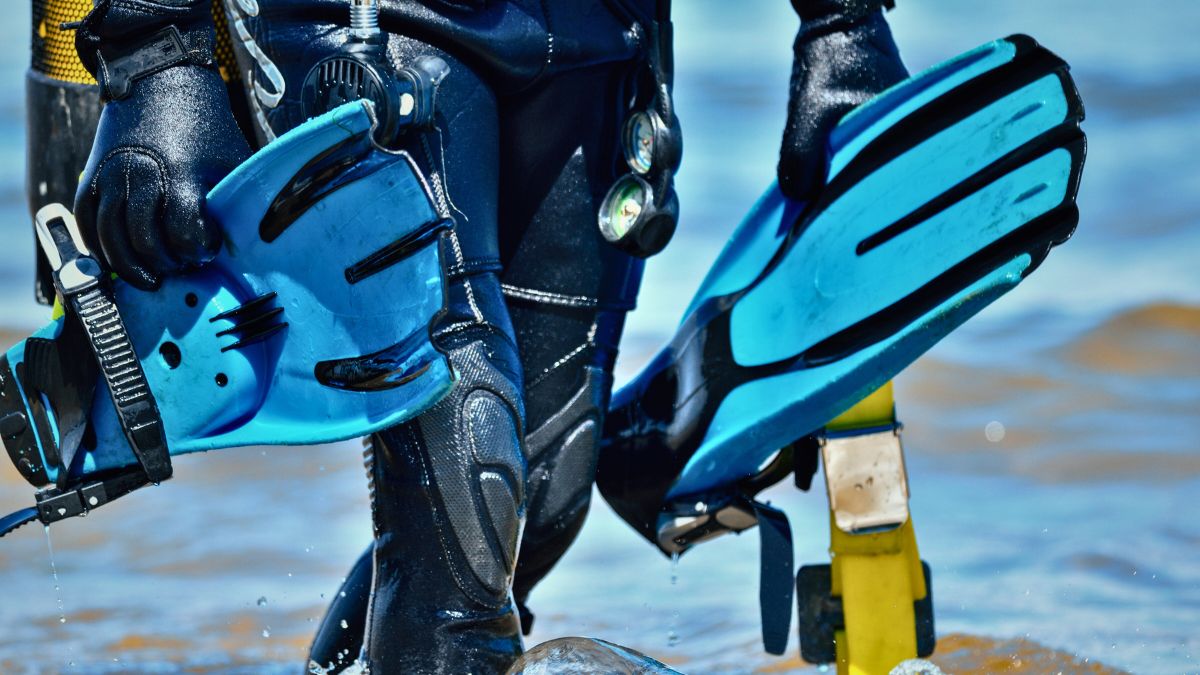
Gear up completely on the beach, but keep your fins off. Carry them in one hand or clip them to your BCD. Walking in fins on land is awkward and risks damage.
Walk backwards if you have your fins on
Walk backward into the water while shuffling your feet along the bottom. This shuffle serves two purposes. It helps you feel for rocks, holes, or drop-offs you cannot see. It also disturbs bottom-dwelling creatures like stingrays, giving them a chance to swim away before you step on them.
Keep your BCD partially inflated as you wade. When the water reaches your waist or chest, stop and put your fins on. You can float on your back or balance on one leg while a buddy steadies you.
Once your fins are on, swim backward while watching your reference point on shore. This helps you navigate the surf zone and ensures you can find your exit point after the dive.
How Do You Handle Rough Surf Entry?
Rough conditions demand extra caution. If the waves look unmanageable, postpone the dive. No dive site is worth an injury.
When conditions are challenging but acceptable, enter with your fins already on your feet. Put your regulator in your mouth, inflate your BCD fully, and keep your mask in place.
Fun Fact: Experienced shore divers in Hawaii developed the “Maui entry” technique. It involves timing your entry with wave sets and using rip currents to help carry you past the surf zone. Mastering it takes years, but it shows how local divers adapt techniques to their specific conditions.
Walk sideways into the waves. This stance minimizes the impact of incoming water on your body. Keep your knees slightly bent for balance.
Move during the lulls between waves when possible. When a wave hits, brace yourself and hold your ground. Do not fight the water. Let it push past you, then continue forward.
As soon as you reach sufficient depth, deflate your BCD and descend to the bottom. Conditions are almost always calmer below the surface. Use your hands to pull yourself along the bottom toward deeper water where you can begin swimming normally.
What Is a Negative Entry and When Do Divers Use It?
Most entry techniques assume you want positive buoyancy at the surface after entry. The negative entry works differently.
In a negative entry, you enter the water with an empty BCD and immediately begin descending. You do not stop at the surface. You do not wait for your group. You go straight down.
Drift diving often requires this technique. Strong currents can quickly separate divers who linger on the surface. A negative entry keeps the group together. It is also useful at sites with boat traffic where minimizing surface time is safer.
This method requires practice and training
To perform a negative entry, use a giant stride or back roll as normal, but with no air in your BCD. Hold your breath briefly as you enter, then exhale fully as you hit the water. This exhalation helps you start sinking immediately.
Keep your body streamlined with your head down or feet down depending on the dive plan. Equalize early and often as you descend quickly.
Negative entries require experience and confidence. I do not recommend them for new divers or unfamiliar dive sites. Practice in controlled conditions before using this technique in challenging environments.
How Do Water Entry Techniques Differ in Costa Rica?
Diving in Costa Rica involves specific conditions worth knowing.
Many Pacific coast dive operations use pangas. These small fiberglass boats with outboard motors require back roll entries. Some newer dive boats have platforms suitable for giant strides, but back roll proficiency is essential for diving here.
Currents at popular sites like Isla del Caño and the Catalina Islands can run strong. Dive operators often request negative entries to keep groups together. If your divemaster calls for a negative entry, make sure you are comfortable with the technique before the dive.
Shore diving opportunities exist at some beaches, but most premier sites are boat-access only. When shore diving is available, conditions tend to be calmer than in Hawaii or Southern California. Still, check with local operators about current surf conditions before attempting any shore entry.
Frequently Asked Questions
Which water entry method is best for beginners?
The giant stride is the most beginner-friendly entry for boat diving. It is intuitive, easy to learn, and gives you positive buoyancy at the surface. For shore diving, the calm-water wading entry is the best starting point.
Can I lose my equipment during a water entry?
Yes, it happens more often than you might expect. Masks and fins are the most commonly lost items. Proper hand positioning and equipment security prevent most losses. Always double-check your mask strap tightness before entry.
How do I know which entry method to use?
Let the dive site and boat type guide you. Large stable boats mean giant stride. Small inflatables mean back roll. Shore access means wading. Low platforms near the water mean seated entry. When uncertain, ask your divemaster what method works best for that specific situation.
Is it normal to feel nervous before entering the water?
Absolutely. Even experienced divers feel anticipation before entries, especially at new dive sites. Some nervousness keeps you alert. If your nervousness becomes anxiety that prevents clear thinking, take a moment to breathe and calm yourself before proceeding.
What should I do if I surface and my mask is flooded?
Stay calm. Keep your regulator in your mouth and breathe normally. Clear your mask using the standard technique from your course. If you cannot clear it, inflate your BCD fully, signal to the boat that you have a problem, and wait for assistance.
Start Practicing Your Water Entry Techniques
Mastering how to dive into the water gives you confidence before every dive. Whether you are stepping off a liveaboard in the Maldives or rolling backward off a panga in Costa Rica, the fundamentals stay the same.
Practice these techniques in calm conditions until they feel automatic. Pay attention to your body position, your hand placement, and your equipment security. Watch experienced divers and learn from their smooth, controlled entries.
The water is waiting. Now you know how to get in.