The first time I saw a manta ray at Isla del Caño, I almost forgot to breathe. I had been diving for years at that point, seen plenty of big animals, and thought I was past the phase of being genuinely startled underwater. Then this shape appeared from the blue – wider than I am tall, moving with a slowness that somehow felt faster than anything I expected – and every thought left my head except one: stay still and watch.
I’ve had dozens of manta ray encounters since then, and I still feel a version of that first moment every single time. These animals do something to you. Maybe it’s the size. Maybe it’s the silence. Maybe it’s the fact that they seem completely unbothered by your presence, gliding past with an indifference that feels, somehow, respectful.
This guide covers everything I know about manta rays – the biology, the behavior, the conservation situation, and what it’s actually like to share the water with one. Some of it comes from research. Most of it comes from watching them.
What Exactly Is a Manta Ray?
Manta rays are large cartilaginous fish – meaning their skeleton is made of cartilage, not bone, just like sharks. They belong to the family Myliobatidae (eagle rays) and the subfamily Mobulinae, which groups them together with the smaller devil rays. They are closely related to sharks and stingrays, and they share the characteristic of giving birth to live young rather than laying eggs.
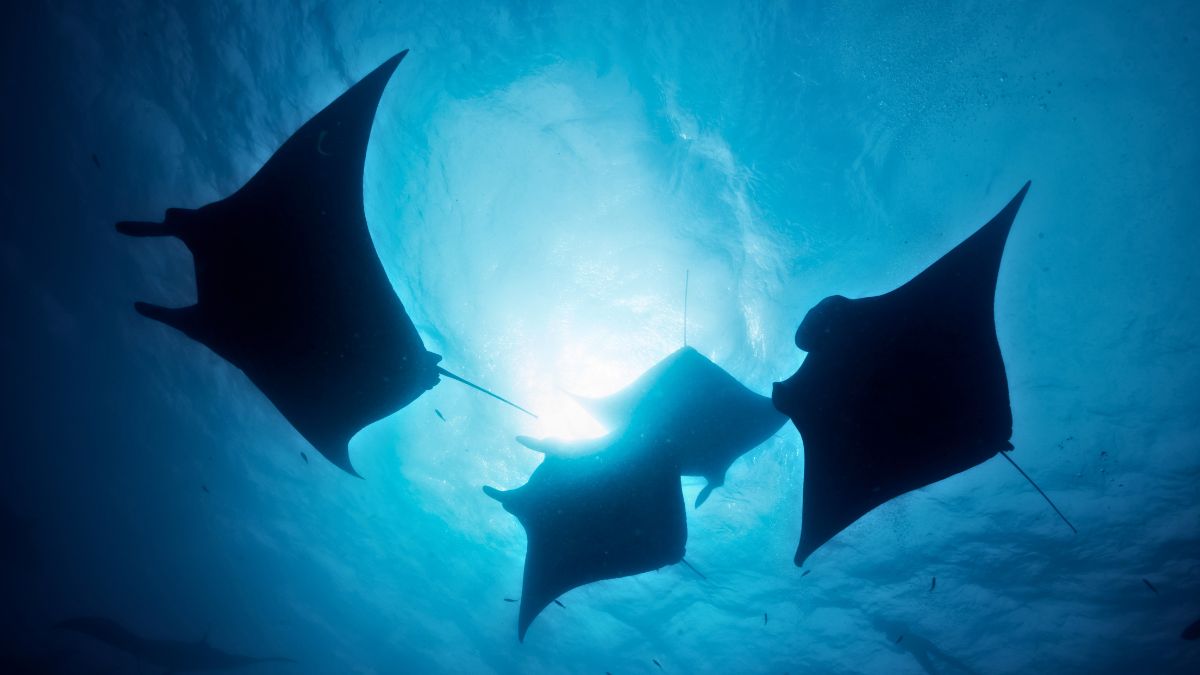
The name “manta” comes from the Spanish and Portuguese word for cloak or blanket. It’s a reference to a traditional trap: fishermen would use a large blanket-shaped net to catch rays, and the animals themselves reminded people of that shape draped over the water.
They were also called “devilfish” for centuries, because their cephalic fins – the two paddle-like appendages on either side of their mouth – curl up when not in use and look unmistakably like horns. It’s an unfair nickname for an animal that has never harmed a human being.
Unlike stingrays, manta rays have no stinger. They have no barbs, no venom, and no meaningful defense mechanism other than speed and size. They are, in every practical sense, harmless.
Three Species of Manta Rays: What Makes Each One Different
Most articles about manta rays describe two species. As of 2020, that number is three – and the third one is particularly relevant if you’re diving in Costa Rica.
Giant Oceanic Manta Ray (Mobula birostris)
The largest manta ray species and the largest ray in the ocean. The giant oceanic manta ray can reach a wingspan of up to 7 meters (23 feet) and weigh up to 1,360 kilograms (3,000 pounds). It’s a pelagic species, meaning it lives in open water and migrates across entire ocean basins, sometimes covering thousands of kilometers between feeding and breeding grounds.
You can identify the giant manta by the dark triangular patches on its shoulders (the “shoulder patches”), which are visible from below as white areas with dark edges. Its coloration is typically dark gray to black on the dorsal side and white on the ventral side, often with dark spots near the gill slits.
The giant oceanic manta is currently listed as Endangered on the IUCN Red List. Its populations have declined significantly due to targeted fishing for its gill plates and accidental bycatch.
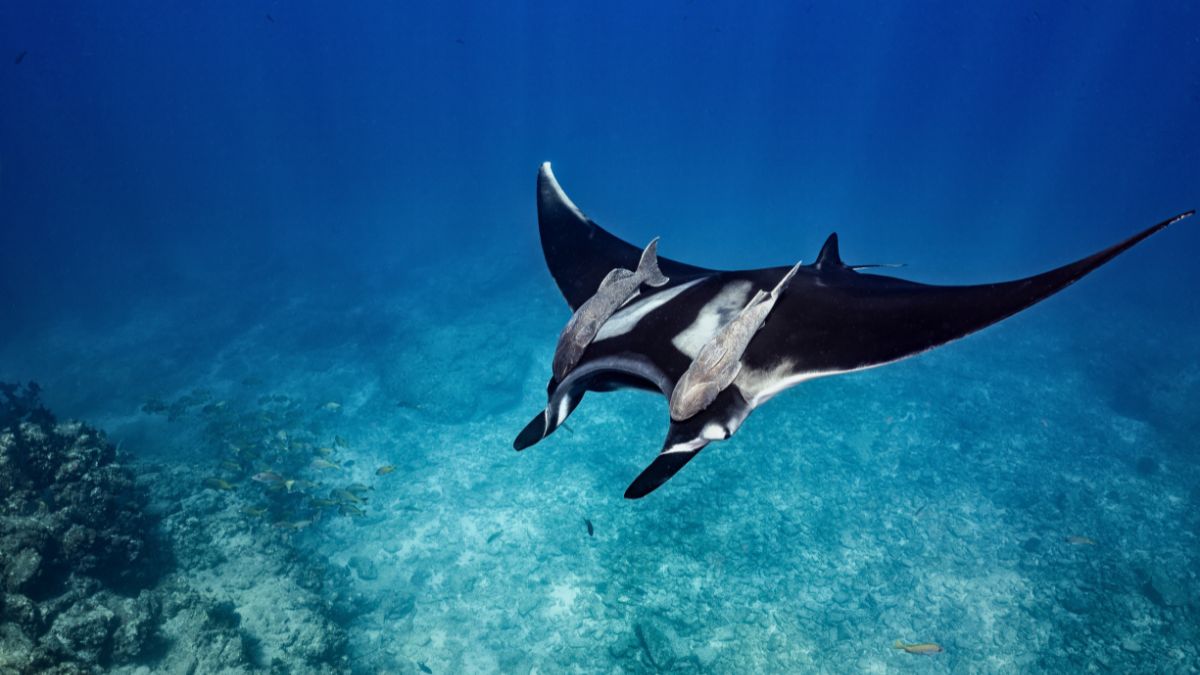
Reef Manta Ray (Mobula alfredi)
Smaller than its oceanic cousin but still enormous by any reasonable standard, the reef manta ray reaches a wingspan of around 5.5 meters (18 feet). It tends to live in shallower, coastal waters and is far more resident than the oceanic species – returning to the same cleaning stations and feeding grounds year after year.
This residency is part of what makes reef mantas so well-studied. Researchers can identify individual animals by the unique pattern of spots on their ventral side, which work like a fingerprint. Organizations like Manta Trust maintain databases of thousands of identified individuals worldwide.
The reef manta ray is listed as Vulnerable on the IUCN Red List, with decreasing population trends.
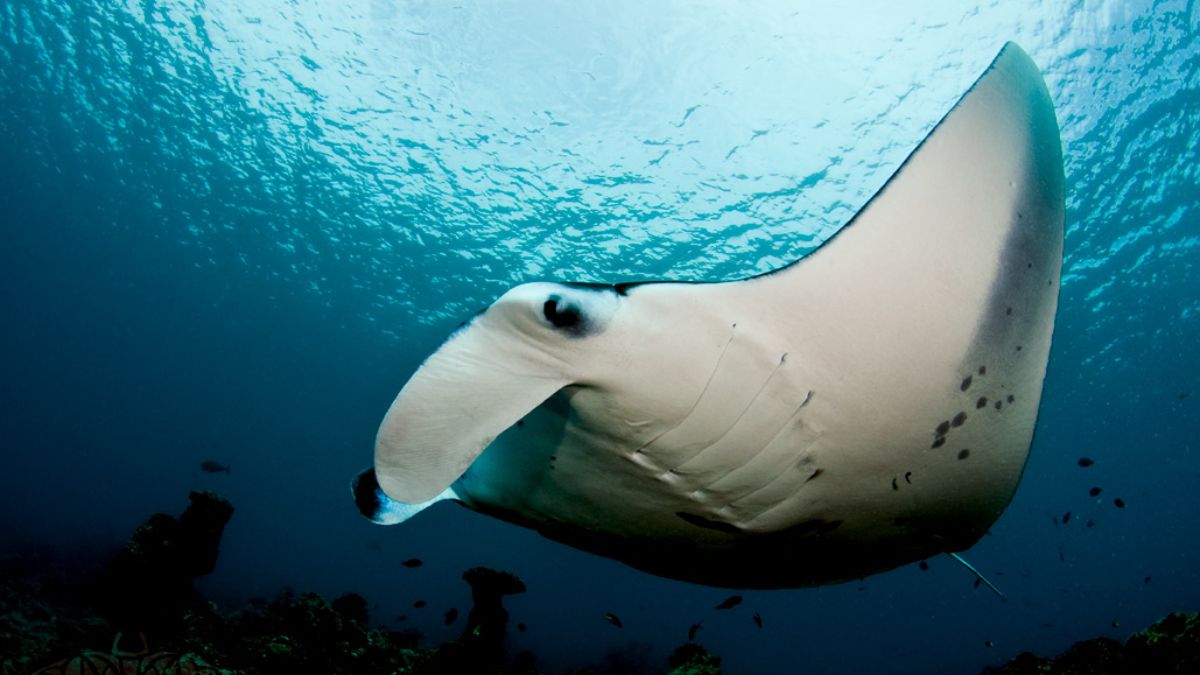
Atlantic Manta, Mobula yarae – The Third Species Most Articles Miss
In 2020, scientists formally described a third species: Mobula yarae. It can reach a wingspan of around 6 meters, placing it between the reef manta and the giant oceanic in size. Crucially for us, Mobula yarae is found primarily in the eastern Pacific Ocean, which includes the waters off Costa Rica’s Pacific coast.
This matters. When you see a manta ray at Isla del Caño or along the Costa Rican Pacific coast, there’s a real chance you’re looking at a Mobula yarae rather than a Mobula birostris. The species was only formally described five years ago, which means most of what we think we know about “giant manta rays” in this region may need to be revisited as researchers gather more data on yarae’s specific range, behavior, and population.
The fact that almost no diving or marine life blog has updated its content to include Mobula yarae tells you something about how slowly accurate information travels. Consider this your update.
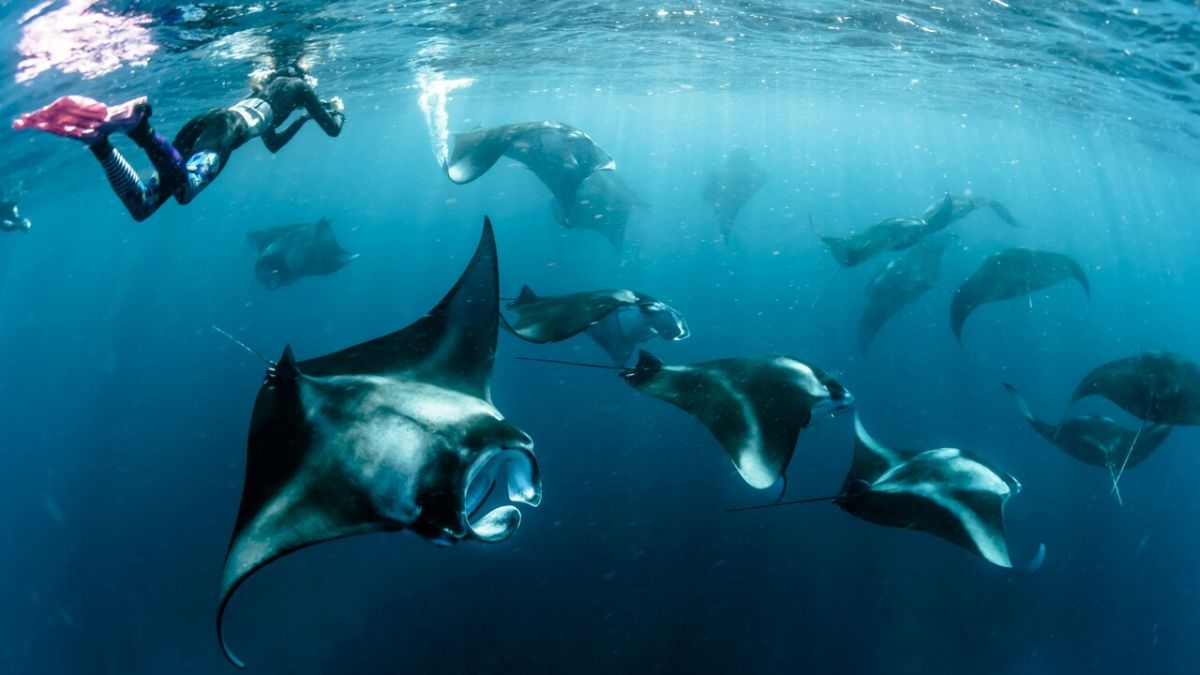
How Big Are Manta Rays? Size, Weight, and Lifespan
The numbers are worth sitting with for a moment. A mature reef manta female can measure 4 to 5 meters from wingtip to wingtip. That’s roughly the width of a typical living room. A giant oceanic manta at 7 meters is wider than a city bus is long. There are unconfirmed historical accounts of specimens approaching 9 meters, though these have never been scientifically verified.
Weight varies enormously by species and individual, but a large giant manta ray can weigh over 1,300 kilograms. When one passes directly overhead, which happens if you stay still and they’re curious, you become acutely aware of exactly how much animal that is.
Manta rays live for a very long time
Lifespan is harder to pin down. Current estimates suggest manta rays can live between 50 and 100 years. The evidence for this comes partly from long-term monitoring programs: a reef manta known as “Lefty” has been photographically documented around Hawaii’s Big Island for over 45 years, and she was already a mature adult when first recorded. Whether that represents the typical lifespan or an exceptional individual remains unknown.
Did you know? Scientists identify individual manta rays by the unique pattern of spots on their ventral (belly) side. No two mantas have the same pattern, making these markings as distinctive as a human fingerprint. Manta Trust has catalogued over 5,000 individual mantas in the Maldives alone.
What Do Manta Rays Eat – and How?
Here is something that never stops being remarkable to me: the largest ray in the ocean eats some of the smallest organisms in the ocean. Manta rays are filter feeders, surviving almost entirely on zooplankton – copepods, mysid shrimp, arrow worms, and fish larvae so small you’d need a magnifying glass to see them clearly.
A reef manta ray eats approximately 5 kilograms of zooplankton per day. Over a week, that amounts to roughly 12% of its body weight. To put that in context, it’s a similar proportion to what whales consume.
Way of eating
The feeding mechanism is elegant. The cephalic fins – those horn-like appendages – unfurl when the manta is feeding and act as funnels, directing water and plankton into the wide, forward-facing mouth. Inside, modified gill arches called gill plates filter the plankton from the water as it passes through. Nothing about this process requires teeth, which is why manta rays don’t have functional ones.
Mantas have developed three distinct feeding strategies depending on plankton density:
- Surface feeding: Swimming slowly at the surface with the mouth open, sweeping through plankton-rich water. This is the most commonly observed technique and what most divers see when mantas appear to be cruising lazily at the top.
- Cyclone feeding: When plankton is concentrated in a column, mantas swim in tight vertical spirals, creating a vortex that concentrates prey and increases feeding efficiency. Groups of mantas will sometimes do this together in a behavior called chain feeding.
- Somersault feeding: Repeated forward somersaults at the surface, creating a swirling current that traps plankton. This is the most acrobatic of the three and the one most likely to make a diver stop and stare.
At Isla del Caño, I’ve watched mantas feed at depth during current-rich dives. The water there gets nutrient-dense when upwelling currents push cold, plankton-laden water toward the surface. On the right day, at the right time, you’ll find mantas working those currents the way a seabird works thermals.
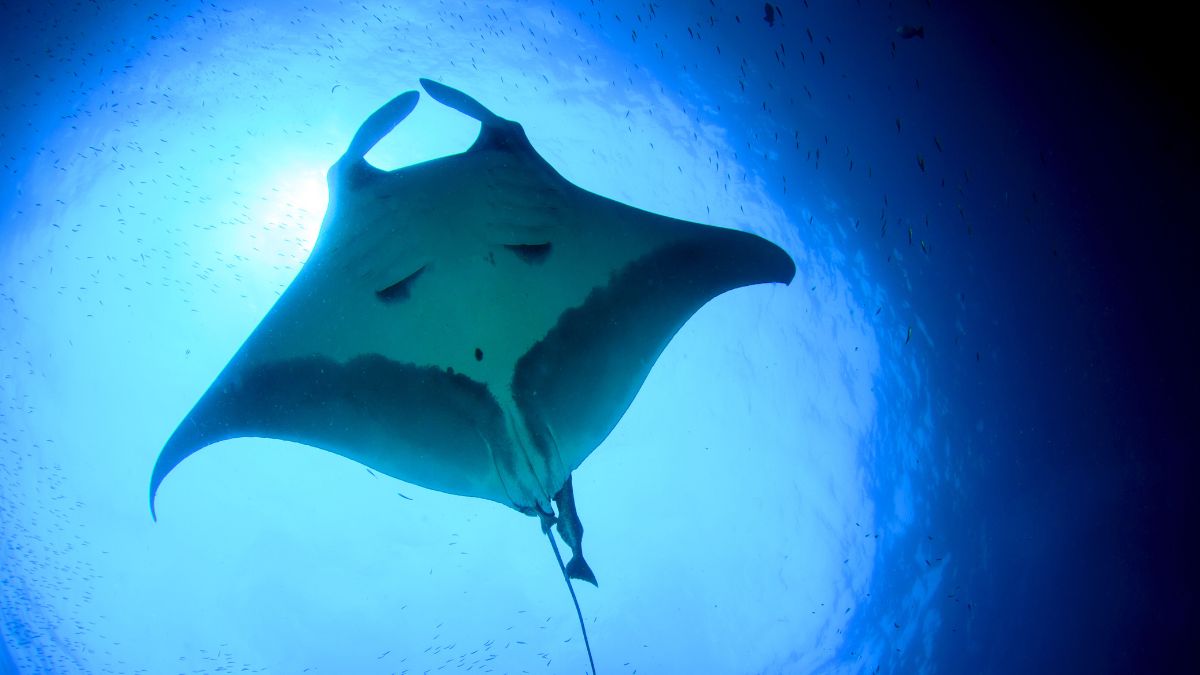
The Manta Ray Brain: The Most Intelligent Fish in the Ocean
Manta rays have the largest brain-to-body ratio of any fish species. This alone would be notable. What makes it genuinely surprising is what that brain appears to do.
In studies on self-recognition, manta rays have shown responses to mirrors that researchers interpret as evidence of self-awareness. When a mirror is placed in their environment, they perform repetitive movements in front of it and inspect their own bodies – behaviors associated with mirror self-recognition in animals like great apes, dolphins, and elephants.
Whether this constitutes true self-awareness in the philosophical sense is debated, but the behavioral evidence is striking for a fish.
They are very curious and friendly
Manta rays also demonstrate what can only be described as curiosity. They will approach divers, circle them, make eye contact, and linger.
They investigate unusual objects in their environment. They appear to learn from experience – reef mantas return to the same cleaning stations repeatedly, remember where productive feeding grounds are, and seem to recognize individual dive boats and divers over time.
I don’t have scientific data to support the last observation. What I have is years of watching mantas at Caño behave differently around boats and divers they encounter regularly versus ones they’ve never seen.
Whether that’s memory, learned caution, or something else entirely, I genuinely don’t know. But it’s one of the things that keeps bringing me back.
Fun fact: Manta rays have retia mirabilia – networks of blood vessels in their brain that may help maintain a warmer brain temperature than the surrounding water. A similar structure is found in warm-blooded animals. Researchers believe this may contribute to the manta’s advanced cognitive abilities.
Behavior: Breaching, Cleaning Stations, and Social Life
Manta rays are generally solitary animals. Most of the time, if you encounter one, it’s alone. But solitary doesn’t mean simple, and there are specific contexts where mantas gather in significant numbers.
Breaching
Breaching is probably the most dramatic manta behavior, and also one of the least understood. Mantas launch themselves completely out of the water, sometimes reaching several meters of altitude, and re-enter with a belly flop that can be heard from a considerable distance. Groups of mantas will sometimes breach in succession, one after another, in what looks unmistakably like coordinated behavior.
Why do they do it? Researchers have proposed several explanations: communication, courtship display, parasite removal, or possibly just play. The honest answer is that nobody knows for certain. I’ve seen it happen at Caño on a calm day with no obvious trigger, and I’ve seen it happen during what appeared to be a feeding aggregation. Both times it was extraordinary.
Cleaning stations
Cleaning stations are fixed locations, usually on or near coral reefs, where small fish – primarily wrasse and angelfish – remove parasites, dead skin, and debris from larger marine animals. Manta rays are regular visitors to cleaning stations and will hover almost motionless while the cleaner fish work. They queue. Seriously – multiple mantas will wait their turn in a loose line, circling the station until a spot opens up.
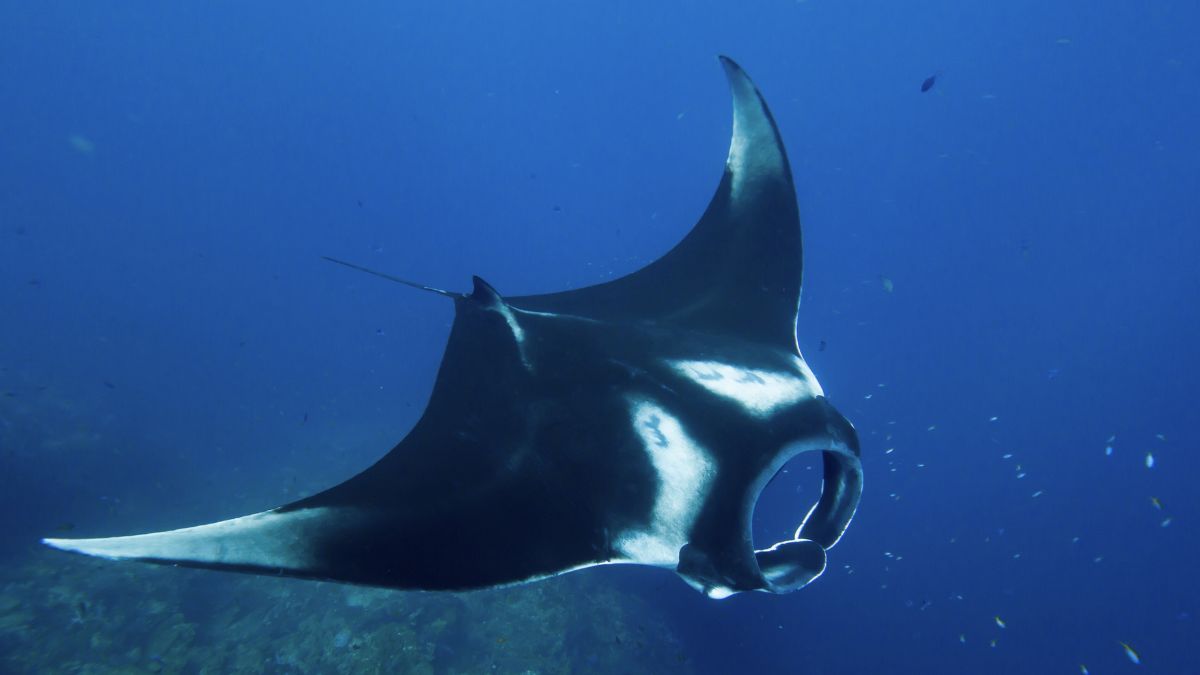
This behavior is one of the best opportunities to observe mantas at close range, because a manta at a cleaning station is focused and relatively still. It’s also one of the situations where diver behavior matters most: approach a cleaning station too aggressively and you’ll spook the manta before the cleaning is done, which disrupts something the animal actively sought out.
Feeding aggregations
Feeding aggregations bring mantas together in numbers that can reach 50 or more individuals when plankton blooms are particularly dense. These aggregations are seasonal and location-specific. Some of the most famous occur in the Maldives, at Hanifaru Bay, where hundreds of mantas have been documented feeding simultaneously during peak season.
Where Do Manta Rays Live? Habitat, Migration, and Costa Rica
Manta rays are found in tropical, subtropical, and warm temperate waters worldwide, generally in areas where water temperature stays above 20°C. Beyond that shared preference, the two main species have very different relationships with geography.
The giant oceanic manta is a true pelagic animal. It travels across open ocean, following productive feeding grounds, and its migrations can span thousands of kilometers. Satellite tracking has documented individual giant mantas crossing entire ocean basins. They are creatures of the deep blue, most at home far from shore.
The reef manta is more coastal and more loyal. Individual animals return to the same locations over years and decades, which is why long-term photo-identification studies have been possible. Their home range is smaller and better defined, though they can still cover significant distances within it.
Manta Rays in Costa Rica
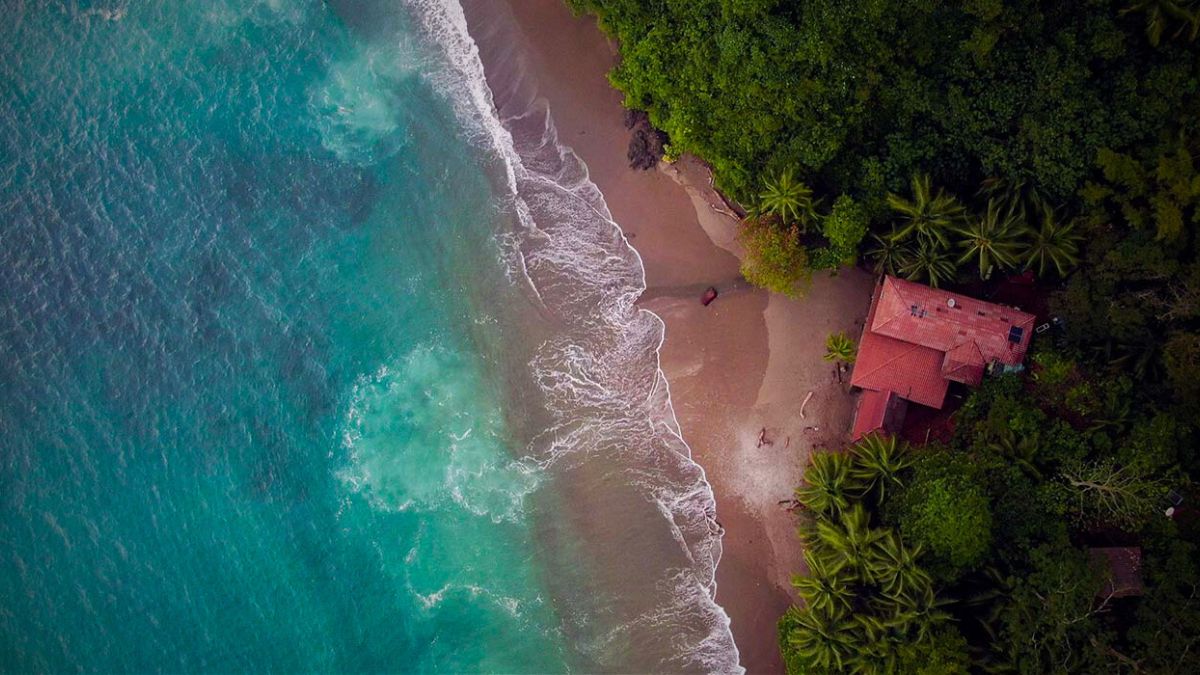
Costa Rica and Isla del Caño sit within the eastern Pacific manta corridor – a stretch of highly productive ocean along the American Pacific coast that supports significant manta populations year-round, with peak activity during certain seasons. The waters around Caño are rich in upwelling nutrients, which drives plankton productivity, which brings mantas. Encounters are most common between December and April, though sightings happen throughout the year.
The presence of Mobula yarae in this region adds another layer: the eastern Pacific may be a primary range for a species we’ve only formally named five years ago. Research is ongoing, and what the diving community observes and photographs contributes meaningfully to that research. If you dive at Caño and photograph a manta, the ventral markings in your photo could help researchers determine which species you encountered.
Beyond Costa Rica, the world’s most reliable manta destinations include the Maldives (reef mantas at cleaning stations), Indonesia’s Raja Ampat and Komodo, Yap in Micronesia (famous for consistent encounters), Hawaii’s Big Island (night dives where lights attract plankton and mantas follow), and Mexico’s Socorro Island, where oceanic mantas are known for unusually close interactions with divers.
Threats and Conservation: Why Manta Rays Are in Trouble
The global manta ray population has declined by an estimated 70% over the last 30 years. That number comes from IUCN assessments and represents one of the steepest declines among any large marine species.
For animals that reproduce as slowly as mantas do – one pup every two to five years, gestation of approximately one year, maturity reached at around ten years – a decline of that magnitude takes generations to recover from, even if all threats were eliminated tomorrow.
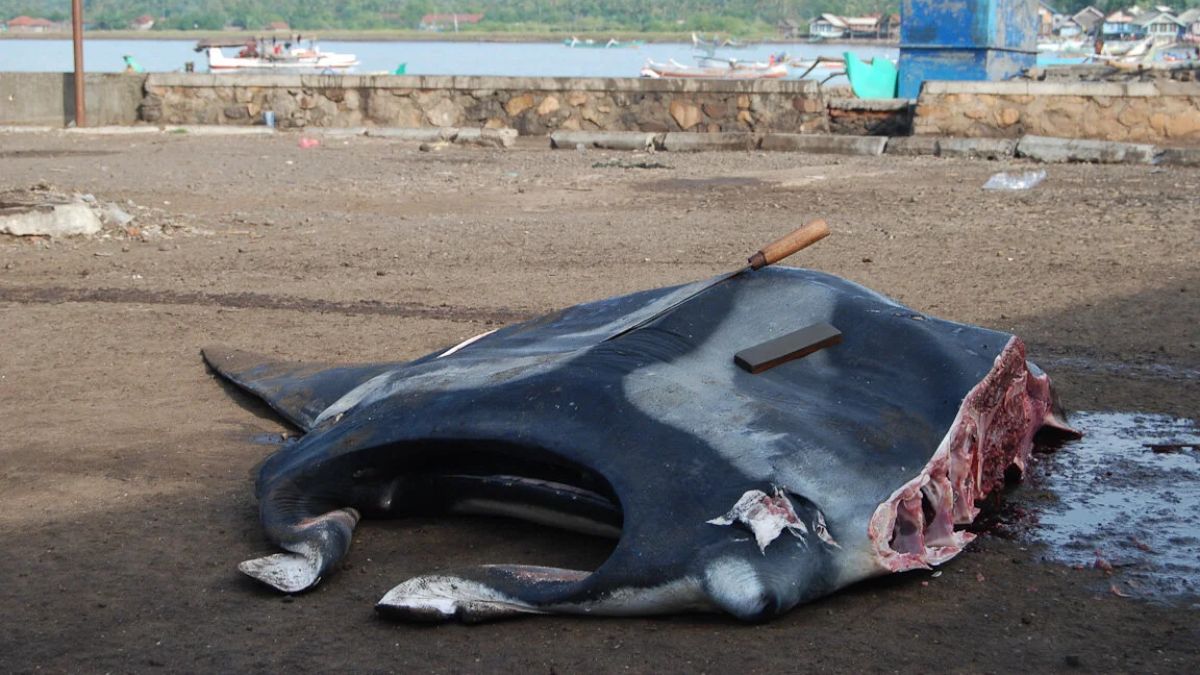
Catching Manta Ray for the gill plate trade
The primary driver is the gill plate trade. Manta ray gill plates – the modified gill arches they use to filter plankton – are sold in certain traditional medicine markets, primarily in China, with claims that they treat a range of conditions.
There is no scientific evidence for any medicinal benefit. There never has been. But the demand has been sufficient to drive targeted fisheries in several countries, and gill plates from a single large manta can sell for hundreds of dollars, creating an economic incentive that conservation messaging alone cannot easily overcome.
Killing manta rays through bycatch
Bycatch is the second major threat. Manta rays are not fast enough to consistently avoid purse seine nets, gill nets, and longlines set for other species. An animal caught in a net and unable to swim forward – which is how mantas breathe – drowns. Bycatch is harder to address than targeted fishing because it doesn’t require anyone to be deliberately hunting mantas; it’s a side effect of fishing pressure on other species.
Plastic pollution and habitat degradation affect mantas through disruption of their food supply. Zooplankton communities are sensitive to ocean temperature and chemistry changes, which means climate change poses an indirect but significant threat to filter-feeding megafauna.
Death due to stress caused by tourism
Unregulated tourism adds pressure in locations with heavy dive traffic. Mantas chased by snorkelers, touched by divers, or repeatedly disturbed at cleaning stations show stress responses and eventually abandon locations they would otherwise use regularly.
Did you know? A manta ray at a cleaning station will sometimes remain almost completely motionless for extended periods, allowing cleaner wrasse to work inside its mouth and around its gills. During these moments, the manta appears to be in a state of deep relaxation – and approaching too quickly will end the cleaning session and deprive the animal of something it actively sought out.
On the positive side: manta rays are now protected under CITES Appendix II, which regulates international trade. Many countries have implemented national protections. Costa Rica has strong marine protections in place around Isla del Caño and Cocos Island.
Organizations including Manta Trust, the Marine Megafauna Foundation, and Project Manta are conducting ongoing population research. Ecotourism, when done responsibly, gives local communities an economic reason to protect mantas rather than fish them.
The conservation math is not hopeless. But it requires the decline to stop first, and then it requires decades of recovery. Both depend on policy, enforcement, and shifting the economic incentives that currently favor exploitation.
How to Dive or Snorkel with Manta Rays – and How Not To
I’ve briefed hundreds of divers before manta dives at Caño, and the guidance I give hasn’t changed much over the years. Most of it comes down to one principle: the manta decides how close this encounter gets, not you.
- Stay still. This is the single most counterintuitive thing I ask divers to do, because the instinct when you see something extraordinary is to move toward it. At Caño, if a manta is in the area and you stop moving, it will often come to you. Mantas are curious animals. A calm, stationary diver is interesting. A diver actively swimming toward them is a potential threat.
- Maintain at least 3 to 4 meters of distance. This is the recommended minimum from most marine conservation organizations, and it’s the distance at which most mantas remain relaxed. Below that distance, you’re in the animal’s personal space, and many will change course or descend.
- Never approach from above or below. These are the manta’s blind spots. Approaching from directly above feels like a predator attack from the animal’s perspective. Approaching from directly below interrupts its field of vision. Come from the side, at the same depth, and let the manta see you clearly.
- Do not touch. Manta rays are covered in a mucus layer that protects their skin and plays a role in their immune defense. A single human hand removes a patch of that mucus and leaves the skin temporarily vulnerable to infection. Beyond the physical impact, touching mantas teaches them that divers are unpredictable and reduces the likelihood that they’ll approach future divers voluntarily.
- At cleaning stations, give space and wait. If a manta is being cleaned, keep your distance and observe. Don’t hover between the manta and the cleaning station. Don’t approach while the cleaning is in progress. If you wait patiently, you’ll often get a much better look than if you rush in – because the manta will finish its cleaning and then, frequently, cruise past you on its way out.
- For night dives: keep your torch pointed down or away from the manta’s eyes. Use red light if your torch has that option. Stay in place and let the manta circle you. Night dive encounters, when done well, are among the most intimate wildlife experiences available to divers anywhere in the world.
Frequently Asked Questions
Do manta rays have a stinger?
No. Manta rays do not have a stinger, barb, or any venom. Unlike stingrays, which belong to a related but different group and possess a venomous barb near the base of their tail, manta rays are completely harmless. Their only defense is their size, speed, and maneuverability. They have never been documented attacking a human being.
How many species of manta rays are there?
Three. The giant oceanic manta ray (Mobula birostris), the reef manta ray (Mobula alfredi), and Mobula yarae, formally described in 2020. Mobula yarae is found primarily in the eastern Pacific Ocean, including Costa Rican waters, and is still being studied. Most older articles describe only two species, as the third was recognized after much of the existing manta ray literature was written.
Are manta rays endangered?
The giant oceanic manta ray (Mobula birostris) is listed as Endangered on the IUCN Red List. The reef manta ray (Mobula alfredi) is listed as Vulnerable. Global populations have declined by an estimated 70% over the last 30 years, primarily due to targeted fishing for gill plates used in traditional medicine markets and accidental bycatch in commercial fisheries. Both species are now protected under CITES Appendix II.
Where can I dive with manta rays in Costa Rica?
Isla del Caño Biological Reserve, located off the Osa Peninsula near Uvita, is the most reliable location for manta ray encounters along Costa Rica’s Pacific coast. Encounters are most common between December and April, though sightings occur throughout the year. Cocos Island, accessible by liveaboard only, offers some of the most dramatic pelagic manta encounters in the world but requires a multi-day expedition.
How intelligent are manta rays?
Manta rays have the largest brain-to-body ratio of any fish. They have demonstrated behavior consistent with mirror self-recognition, show clear curiosity toward divers and novel objects, return to specific locations from memory over years, and appear capable of learning. Whether this constitutes “intelligence” in the way humans use the term is a philosophical question, but the behavioral evidence places mantas among the most cognitively complex animals in the ocean.
Can manta rays be kept in captivity?
Effectively no. Manta rays require enormous volumes of water, continuous movement to breathe through ram ventilation, and a steady supply of live zooplankton that is nearly impossible to replicate artificially. The few attempts to keep mantas in aquariums have resulted in the animals dying within days to weeks. This is one of the reasons that manta ray research relies heavily on field observation rather than controlled studies, and why so much about their biology and behavior remains unknown.
Sources and References
- IUCN Red List: Mobula birostris – official conservation status and population assessment
- Manta Trust: Global Manta Ray Research – individual identification databases
- NOAA Fisheries: Giant Manta Ray – species profile, threats, and protection measures
- CITES: Manta Rays Protection – international trade regulations under Appendix II
- Marine Megafauna Foundation – behavioral studies and conservation initiatives